Showing posts with label UNESCO. Show all posts

Tuesday, June 11, 2019

Jeju's UNESCO World Heritage Sites: Walking Above- and Below- Ground

I checked off Seongsan Ilchulbong and Halla Mountain from my "UNESCO World Heritage Sites to Visit" list when I visited Jeju for the first time in the spring of 2018. Geomun Oreum and Manjanggul Cave would have to be accomplished on the next visit. Luckily, that opportunity came the following year.

거문오름

Directions by bus: From Jeju Intercity Bus Terminal, take bus 211 or 221 to 거문오름입구 Geomun Oreum bus stop (40 minutes).

Jeju Island has 160 lava tube systems, one of which is Geomun Oreum. What's so special about Geomun Oreum? Geomun Oreum has the largest lava tube system in the island.

Geomun Oreum is open to the public for hiking on the oreum, not in the lava tubes (except a section of Manjanggul Lava Tube, which I will get into more detail later). But you can't hike on Geomun Oreum any time, any day, because hikes are scheduled and the number of hikers per day is limited to 450. In short, advance reservation is required.

Geomun Oreum Hiking
Wednesday to Monday 9AM to 1PM
Admission fee: 2,000 won

There are three trails around Geomun Oreum to choose from:

  • Summit Course — 1.8 km / 1 hour 
  • Crater Course — 5.5 km / 2.5 hours
  • Full Course — 10 km / 3.5 hours

I signed my friend and I up for the crater course. No wonder we were the only foreign guests—the guided tour was in Korean! We made many stops, some historical (such as WWII Japanese military tunnels, and old charcoal kiln sites used from the 1900s to the 1970s), some natural (like a lava collapse trench, and a vertical lava tube). I had no clue what the guide was on about at most of them, but I am sure it was something significant. A few areas we stopped at, thankfully, had signboards with an English translation.

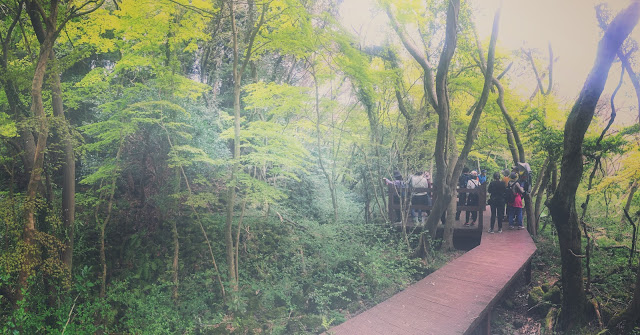
It was a very easy 2.5-kilometer hike: there were no steep climbs and the hiking trail was mostly on a boardwalk. I would probably have appreciated the hike more if they had an English-speaking guide or at least, an English audio guide, or even a brochure.


The highest point (456m) on Geomun Oreum

The ceiling of a lava tube collapsed and formed this "lava collapse trench" or "lava gorge"

The hiking trail was mostly on a boardwalk


Charcoal kiln site (if not for the signboard, I wouldn't have know it was what it was)


Pretty gnarly trees


9AM to 6PM
Admission fee: 3,000 won

The meeting point for the Geomun Oreum hike is at the Geomun Oreum Information Desk, which is just across the Jeju World Natural Heritage Center. For those who don't want to hike around Geomun Oreum, the Jeju World Natural Heritage Center offers an indoor museum, with an exhibit hall and a 4D theater, where one can learn about Jeju Island and its Natural Heritage sites.

While waiting for our Geomun Oreum hike, my friend and I explored Jeju World Natural Heritage Center. The museum staff enthusiastically took us (almost dragged us in his enthusiasm!) to the 4D theater since we were just in time for a show, and though the 20-minute story was entirely in Korean, we did enjoy it!

The Heritage Center is a good place to visit if you want to get a glimpse of Jeju's natural heritage sites but have no time to see (or hike, like Mount Halla or Seongsan Ilchulbong) the real thing. 

Door on the left is for the Jeju World Natural Heritage Center,
door on the right is for the Geomun Oreum Information Desk

Displays of Jeju wildlife, and projected on the background is Mount Halla's crater

A replica of what you can find in Manjanggul Lava Tube

A diorama of the inside of a lava tube


Manjanggul Lava Tube
만장굴
9AM to 6PM (Closed 1st Wednesday of every month)
Admission fee: 2,000 won

Directions by bus: From Jeju Intercity Bus Terminal, take bus 201 to 김녕리 Gimnyeong-ri bus stop (55 minutes) then transfer to bus 711-1 or 711-2 to 만장굴입구 Manjanggul bus stop (10 minutes).

Geomun Oreum has a lava tube system stretching 36 kilometers and includes one of the largest lava tubes in the world: Manjanggul Lava Tube. Manjanggul Lava Tube is about 7.4 kilometers long but only 1 kilometer is open to the public.

Manjanggul Lava Tube has three entrances; the second entrance is the only one that's open to the public. The walk through the lava tube is damp, with puddles here and there (be sure to wear waterproof shoes!). The area is lit and one can see interesting formations caused by lava flow from thousands of years ago, such as lava flowlines, lava stalactites, lava stalagmites, etc. The farther you venture into the tube, the colder it gets. And the reward as you reach the end of the 1-kilometer walk is a large lava column!

The entrance to Manjanggul Lava Tube that's open to the public


Lava column

Jeju and Busan, April 2019
Jeju Accommodation: Jeju R Hotel & Guesthouse
Traveling Around Jeju by Bus Plus KakaoMap (2019)
Eats from Jeju City Restaurants I Can't Read the Names Of
Jeju City Lights: Iho Tewoo Beach and Jeju Light Art Festa
Jeju's UNESCO World Heritage Sites: Walking Above- and Below-Ground (you're here!)
Art and Nature in Seogwipo City
Jeju Olle: Udo Island
Jeju Olle: Gapado Island
Busan Accommodation: One Way Guesthouse
Where and What We Ate in Busan

Saturday, January 19, 2019

UNESCO World Heritage: Namhansanseong Fortress

South Korea currently has fourteen UNESCO World Heritage Sites, two of which are fortresses: Hwaseong Fortress and Namhansanseong Fortress. Both are located in the province of Gyeonggi, just south of Seoul.

I left Seoul around noon planning to have lunch at the Traditional Food Town in Namhansanseong and keeping the sandwich in my bag as an emergency snack for the hike around the fortress. That was mistake number one. Mistake number two was going there on an autumn Saturday. I honestly did not expect Namhansanseong to be so popular. I was stuck in a warm bus crammed with passengers, all the while standing and holding on to straphangers trying not to knock over everyone behind me as the bus moved along and stopped and moved along and stopped on an incline. I don't know how long we were stuck in traffic but it felt like a very long time. I thought I was going to pass out from hunger!!! There was no way I would have the energy to look for food nor go on a hike! Bottom line: Go to Namhansanseong Fortress on a weekday and as early as you can!

Namhansanseong Fortress is 12.4 kilometers in length and is in the mountains, whereas Hwaseong Fortress is only 5.7 kilometers in length and is in the middle of the city. Each fortress has its own beauty. And I can easily see why Namhansanseong is so popular with the locals in autumn—it is surrounded by trees awash in beautiful autumn colors.

There are five hiking courses of varying lengths in Namhansanseong. The shortest one would take only an hour; the longest one would take thrice as long. I was so hungry that I did not care to follow any of the hiking courses. I just went to the nearest section of the fortress that I could find: Nammun or the South Gate, the grandest of the four gates of the fortress.

Nammun or South Gate

Near the South Gate, I plopped down on the first bench I saw with only one thought: wolf down my sandwich! As soon as I was sure the sandwich has stopped my body from wanting to faint, I commenced my hike from the South Gate to the West Gate by following the path along the fortress wall.

Following the path along the wall

Ugh, uphill!

The uphills sections, though not steep, seemed daunting to me and my half-filled stomach. But, I had no choice (I brought this on myself!), and so trudged on. I was rewarded with autumn colors, mountainside views, and city views. Very pretty indeed.

Autumn is my favorite season

Cityview


Following the path along the wall, I found a pavilion, a hidden gate, and Sueojangdae or the West Command Post. There used to be five military command posts around Namhansanseong and Sueojangdae is the only one that remains.


Sueojangdae or West Command Post

Much as I wanted to explore more of the fortress, I was pressed for time: it was almost 5PM. I took a path that would take me down to the roundabout where the bus stops are, passing by Namhansanseong Haenggung.


Sadly, Namhansanseong Haenggung was already closed. Namhansanseong Haeunggung served as a temporary palace in times of war. It is open Tuesdays to Sundays from 10AM to 5PM (closes at 6PM from April to October). Admission fee for the palace is 2000 won.

And because the queue for buses going back to Sangseong Station was too long and I did not want to miss the last bus (I had no idea what time the last bus would be)—I had to forgo, yet again, dinner at the Traditional Food Town.

Guess I will have to plan a visit to Namhansanseong Fortress again in the future!

Directions to Namhansanseong Fortress: Take the subway to Sanseong Station. Go to exit 2 and walk straight ahead for to the bus stop (about 100 meters). Take the bus #9 or #9-1 or #52 to Namhansanseong.


This article is now available as a mobile app. Go to GPSmyCity to download the app for GPS-assisted travel directions to the attractions featured in this article.

Sokcho+Seoul+Gwangju, Autumn 2018
Itinerary and Expenses: 10D/10N Seoul and Sokcho
Sokcho, Gangwon-do
Sokcho Accommodation: With U Hotel & Guesthouse
See Sokcho
Seoraksan National Park
Seoul
Seoul Accommodation: Hostel Tommy
Finding Solace in the Midst of Seoul's Urban Jungle
Art Museums in Seoul
Food for the Seoul
Unhyeongung Palace, Cheong Wa Dae, Jogyesa Temple
Gwangju, Gyeonggi-do
UNESCO World Heritage: Namhansanseong Fortress (you're here!)

Tuesday, July 3, 2018

UNESCO World Heritage: Gyeongju Yangdong Historic Village

I visited Yangdong Village, which is South Korea's largest traditional village, with 160 houses, 54 of which are over 200 years old. It is also one of the two villages included in the UNESCO World Heritage Site called Historic Villages of Korea (the other one is Hahoe Village in Andong). Both villages were founded in the 14th to 15th centuries. The villages are sheltered by mountains and face out onto a river and open agricultural fields. In the villages are residences of the head families, timber framed houses of clan members, pavilions, study halls, Confucian academies for learning, and one storey mud-walled, thatched-roofed houses, formerly for commoners.

At the entrance of the village is a museum (free admission) where one can learn about the history of the village, its clans, and the existing buildings that have been designated as cultural heritage properties.


A diorama of Yangdong Village

A miniature model of one of the important residences in the village


I checked out the 22 cultural heritage properties by walking around the village and visiting each (I was given a map when I paid for the admission fee). The hunt for these properties was a workout for these houses were almost always on higher ground, some with steep roads.


Gwangajeong, means "to see the harvest," named such because it was located where one had a view of the plain and river in the distance. It was built around 1500 by a Confucian scholar-official of the Joseon Dynasty.


Hyangdan

Hyangdan was built in 1543 at the order of King Jungjong for Yi Eon-jeok, the governor of Gyeongsan Province.


Mucheomdang is a detached building of the head family house of Yi Eon-jeok. The wooden-floored center hall is used for ancestral rites and to receive guests.

If I got lost, this directional post would be of no help to me.

Seobaekdang, built in 1459, is the head family house of the Son clan. The 7-meter tall juniper tree in Seobaekdang has branches spreading 12 meters in diameter, and is about 600 years old!


Yangdong Village is very quiet and peaceful. (And there were less than ten visitors that day.) People still live in the village and I was careful to follow the map and not trespass on private property. The houses and school buildings in the village that have been designated as important cultural properties can be viewed from the outside, but cannot be entered.

Gyeongju Yangdong Village
경주 양동마을
Daily 9AM to 6PM
Admission fee 4000 won

Directions to Gyeongju Yangdong Village: At Gyeongju Intercity Bus Terminal, take bus 203 to 양동마을입구 Yangdong Village Entrance bus stop (1300 won cash/1250 won transportation card; 35 minutes). Bus 203 is the only bus that goes direct to the village, it is important to note the bus schedule. If you miss bus 203, you can take bus 206 and get off at 양동마을 Yangdong Village bus stop then walk about 750 meters (8 minutes) to Yangdong Village.

Bus 203 Schedule
Gyeongju Intercity Bus Terminal to Yangdong: 915AM, 1030AM, 1210PM, 130PM, 330PM, 450PM
Yangdong to Gyeongju Intercity Bus Terminal: 1035AM, 1155AM, 135PM, 255PM, 455PM, 625PM


This article is now available as a mobile app. Go to GPSmyCity to download the app for GPS-assisted travel directions to the attractions featured in this article.


South Korea Spring 2018
Jeju Accommodation: Sum Guesthouse Jeju Airport
Traveling Around Jeju by Bus
Checking out Cafes in Jeju
Jeju: Location, Location, Location (for a Photoshoot)
Jeju Eats
History and Nature in East Jeju
UNESCO World Heritage Sites in Jeju
Hiking Hallasan via Yeongsil and Eorimok Trails
Daegu International Airport to Gyeongju
Gyeongju Accommodation: Chacharang Guesthouse
UNESCO World Heritage: Gyeongju Historic Areas
Walking Around Gyeongju
UNESCO World Heritage: Gyeongju Yangdong Historic Village (you're here!)
Joining the Cherry Blossom Loving Crowds in Jinhae
Cherry Blossom Binge Continues in Busan
Busan Museum of Art
Spring 2018 Jeju and Southeast South Korea Itinerary and Expenses