Showing posts with label Kansai. Show all posts

Monday, April 24, 2023

Kyoto Accommodation: M's Hotel Sanjo Omiya

M's Hotel Sanjo Omiya is three storeys high and the upper floors can be accessed by stairs or by elevator. Entry to the hotel and the room is keyless. Self check-in was easy.

The 17-square-meter twin room had, of course, twin beds. There was a power outlet between the beds. Across the beds there was a desk, chairs, TV, refrigerator, kettle, mugs, and free tea.


The ensuite toilet and bath (shower and tub) was a bit small which, for Japan, is not surprising. Shampoo, soap, toothbrush, towels, and slippers were provided.

The lobby had a small "amenities bar" (razor, cotton buds, cotton, hair brush) available for free for guests. It also had a microwave. The hotel also has a washing machine and dryer.


The hotel is in a quiet area. Just around the corner are restaurants, a convenience store, and a supermarket. Although Kyoto Station is more than 3 km away, there is a bus stop nearby, and there are four stations about 10 minutes (or less) on foot:
  • 400meters from Nijojo-mae Station
  • 600 meters from Omiya Station—Omiya Station has a direct train to Osaka (Hankyu Line)
  • 600 meters from Shijo-Omiya Station—direct train to Arashiyama
  • 1 km from Nijo Station
My sister booked M's Hotel Sanjo Omiya in Kyoto. If I were to choose, I would not have booked this hotel. Not because it's a dump (it was very clean!), but two reasons: one, I am cheap and this was way over my budget (for four nights, we spent 51689 JPY for a twin room, plus 200 JPY/night/person for the tax); and two, although the hotel is near four stations, none of these stations had direct trains going to the airport (I would have preferred to stay near Kyoto Station since this was our last stop of the trip). 

But if money is not an issue, M's Hotel Sanjo Omiya is actually a pretty good choice.

Tuesday, April 18, 2023

Temples and Cherry Blossoms in Mount Yoshino (Nara)

Although we were a week late for the peak cherry blossoms, my father and I hopped on the train in Osaka-Abenobashi Station to go to Yoshino Station (90 minutes, 1170 JPY per way) in the hopes of seeing some cherry blossom trees in Mount Yoshino. Mount Yoshino is a popular place in Nara for cherry blossom viewing, because it is said to be covered in about 30,000 cherry blossom trees!

Yoshino Station is on the foot of Mount Yoshino. To get to Yoshino Town up on the mountain, one has to take a cable car (or another option during cherry blossom season, a shuttle bus).

From Yoshino Station, it is a short walk to Senbonguchi Ropeway Station (for the cable car) and the shuttle bus stop. This 1-minute walk will become a 15-minute walk with stops at the Tourist Information Center and the four to five shops selling food and souvenirs.

Seeing a shop selling kakinoha-zushi (sushi wrapped in persimmon leaf), which I had learned about when I joined a walking tour in Naramachi in 2016 but had not had the chance to try, I bought a small box for a quick breakfast. My father and I had our quick kakinoha-zushi breakfast (and no, the leaf is not for eating, it is only used to preserve the sushi) on one of the low wooden benches in front of the shop. I had to gulp down water to wash away the fishy-vinegary taste of the kakinoha-zushi, one of the few Japanese food that did not agree with my tastebuds.

kakinoha-zushi

To get to the Yoshino Town, I opted for the shuttle bus (450 yen), since this would take us farther up the mountain than the ropeway, thinking it would be easier on our knees to walk back down. What none of my research told me was that the final stop of the shuttle bus would welcome us with stairs! Though there were not that many steps, it was way too many steps for my 70-year-old father who hasn't exercised in a long time. My father, trooper that he is, huffed and puffed up the stairs so we could get to the road that led to shrines, temples, souvenir shops, and restaurants.

During the cherry blossom season, there are also mini buses that would take visitors from Nakasenbon to Kamisenbon, farther up the mountain. I wanted to go to Kamisenbon, but with the long queue, it looked like everyone else wanted to go, too. This and the thought of letting my father walk a lot made me change my mind. So it was just Nakasenbon for now.

We had a look-see in Sakuramotobo Temple, which had some cherry blossom trees.

We also came across a parking lot that had a nice view of a mountainside with cherry blossom trees.

This mountain town is also home to three World Heritage Sites: Mikumari Shrine, Yoshimizu Shrine, and Kinpusenji Temple. But I only managed to visit the latter two.

Yoshimizu Shrine 吉水神社 (open daily from 9AM to 5PM, 600 yen admission fee) was founded in the 8th century and was originally a temple. If you're into Japanese history, this shrine would be of interest for, over the years, it hosted some important Japanese historical figures, such as Emperor Go Daigo and Toyotomi Hideyoshi. In Yoshimizu Shrine's Shoin (library-like building), there are exhibits relating to these important persons. As a bonus, Yoshimizu Shrine also has an area that offers an unobstructed view of the mountain's cherry blossom covered slopes.

Entrance to Yoshimizu Shrine

Yoshimizu Shrine's Shoin

Exhibits inside Yoshimizu Shrine's Shoin

View from Yoshimizu Shrine

Kinpusenji Temple 金峯山寺 (open daily from 830AM to 4PM, 800 yen admission fee for Zao-do Hall) is the most important Shugendo temple in Yoshino. Shugendo is a religion based on a combination of Buddhist and Shinto beliefs. Kinpusenji's 34-meter tall Zao-do Hall is the second largest wooden structure in Japan (the largest is Todaiji Temple, also in Nara).

Zao-do Hall of Kinpusenji Temple

In between shrine/temple visits, we ate whatever caught our eye: kuzumochi, sakura ice cream, roasted chestnuts, and gohei mochi.

Kuzumochi

I would have wanted to explore more, but my father was tired, and we called it a day after just three hours. This time, to return to Yoshino Station, instead of taking the shuttle bus, we got on the cable car (450 yen, departs every 15 minutes).

Yoshino deserves more than just three hours and I hope to return some day.


This article is now available as a mobile app. Go to GPSmyCity to download the app for GPS-assisted travel directions to the attractions featured in this article.

Monday, April 10, 2023

Osaka Accommodation: Hotel 3 O'Clock Tennoji

Because I prefer staying near a station where there is a direct train to the airport, I booked a room for my father and me at Hotel 3 O'Clock Tennoji.

Location. Hotel 3 O'Clock Tennoji is just 250 meters from JR Tennoji Station Parkside Gate exit. There are convenience stores, restaurants, and malls nearby. Tennoji Zoo is just across the hotel, and Shinsekai is just a 13-minute (900 meters) walk away. Tennojiekimae Station, where you can take the old-fashioned tram to Sumiyoshi Taisha, is only 450 meters from the hotel.

Room. We stayed in a double room. The room was very clean. It had a double bed, TV, refrigerator, kettle, table, chairs, and hangers. There were outlets on each side of the bed. WiFi is also available.

Toilet and Bath. The room had a surprisingly good-sized ensuite toilet, sink, bath tub, and shower. Towels, shampoo, conditioner, and bath gel were provided. What I like about Japanese T&Bs is that the toilet is separate from the bath. This is especially convenient for rooms that accommodate two or more people.


Amenities. The hotel is four storeys, and the upper floors can be accessed by elevator or stairs. Entry to the hotel and rooms are via keycard. A washing machine and dryer are available for a fee. There is also a small cafe at the ground floor.

Service. Although the owners couldn't speak English, they used Google translate to communicate. The service was superb. I was surprised that they had a welcome drink, provided bottled water daily, and changed the towels daily. Hair ties, comb, razor, sponge, cotton, etc were also available for free at the lobby.

I would definitely stay here again!

Saturday, April 8, 2023

Kansai Airport to Osaka City (Tennoji, Osaka, or Shin-Osaka Station)

There are two railway companies that serve Kansai Airport: Nankai and Japan Railways (JR). On my 2016 trip, I took the Nankai Airport Express to Osaka City's Shin-Imamiya Station. But on my recent trip, since I was staying near Tennoji Station, I took the JR Kansai Airport Express "Haruka" train.

But before doing so, I queued up at the JR West Ticket Office. Although I already had an ICOCA (IC card) and could just add money to it at the machine, tap in at the station gate, and be on my way, it was still worth my time to queue and buy a JR Kansai Airport Express Haruka ticket at the Ticket Office. Why? JR West had a ticket deal wherein if you have an ICOCA, you only pay 1200 JPY for a reserved seat ticket to Tennoji Station instead of 2170 JPY (a non-reserved seat ticket would cost 1840 JPY). The journey takes 33 minutes. Other than Tennoji Station, the Haruka also stops at Osaka Station, and Shin-Osaka Station (the discounted Haruka ticket price is 1600 JPY for either of these two destinations).

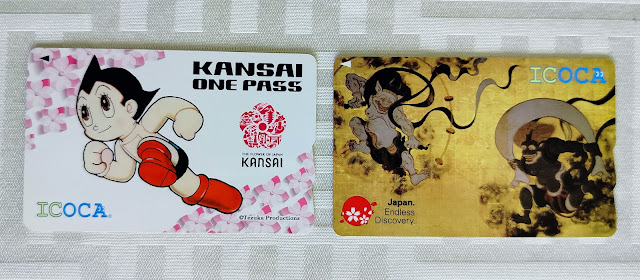
My ICOCA (left) which I have had since 2016,
and my father's ICOCA (right) which we bought on this trip.

If you don't have an ICOCA, you can still buy the ICOCA + Haruka ticket at the JR West Ticket Office. The ICOCA would cost 2000 JPY, which already includes 1500 JPY worth of credits. The ICOCA can be used for public transportation (trains, subways, buses, trams), lockers, vending machines, and convenience stores.

Although the website states that you could buy discounted Haruka tickets at other stations, I found it was not so. On our last day in Japan, we were going to buy our discounted Haruka ticket (Kyoto to Kansai Airport Station) at Kyoto Station, but the station staff said it was only for sale at Kansai Airport Station. It was such a bummer to pay 2730 JPY when I knew I could have paid only 1800 JPY had I known it was only for sale at Kansai Airport Station. Argh. So, if you have reached this far, I have one valuable tip for you: make sure to also buy your return ticket at Kansai Airport Station!

Wednesday, November 1, 2017

Wisdom from the Road #57

On waking up early
They say: The early bird gets the worm.
I say: The early bird gets to avoid the crowd.

I probably won't make a good travel buddy because I wake up early (no matter how much I want to sleep in, I always wake up early) and go to wherever it is I am going before everyone else has had breakfast. The advantage of this is that I get to enjoy the place (especially if it's a touristy one) before the droves of people come.

Exhibit A: Arashiyama Bamboo Grove in Kyoto. The beautiful photos we see on the internet that had us putting the bamboo grove on our to–visit list is always a picture of tranquility. To catch this zen moment means arriving early.

There were only half a dozen souls at the bamboo grove at 830am.

I arrived at the grove around 830AM and there were only five or six other people there. When I passed by the grove again in the afternoon, around 2PM, it was flooded with people. It was an "expectation versus reality" moment, and not a smidgen of zen.

The 2pm crowd

I have no Exhibit B, but you get my drift.

Monday, October 23, 2017

Kansai Diaries, Day 9: Osaka, Over and Out

December 1, 2016

Ah, the ninth and last day of my solo Kansai trip. Today I will be visiting two museums, one of which is in Toyonaka City, north of Osaka City, and I start my day early wanting to arrive at the Open Air Museum of Old Japanese Farmhouses as it opens. I use the 1-Day Osaka Visitor's Ticket  (can be used on Osaka's municipal subway, tram, and buses) that I had bought for 550 yen at Kansai Airport on the day I arrived.

I take the red line to Esaka Station (the last stop) and transfer to the Kita-Osaka Kyuko Railway. The automatic gate bars me from entering. Oops. My pass is not valid in this railway and I ask for help from the station attendant. Without her uttering a word in English, she helps me at the machine where I have to pay 90 yen for fare adjustment.


Nearest Station: 4-minute walk from Ryokuchikoen Station

I arrive at Hattori Ryokuchi Park, where the Open Air Museum of Old Japanese Farmhouses is located. It's a huge park. The size overwhelms me; I have to gather my wits about. As I wend my way through the park in the general direction of the museum, I observe a man sleeping on a bench, flower beds abloom, and a bunch of kids on a school outing.


I finally reach the museum. Students clad in suits are lingering outside. I—we are a few minutes early. Good, I can eat my breakfast on a nearby bench. By the time I come back the students have disappeared.


日本民家集落博物館
Tuesday to Sunday 930AM to 5PM
Admission fee: 500 yen

Nearest Station: 10-minute walk from Ryokuchikoen Station

Even as I pay for my ticket, I am already transported to the Edo period—the ticket office is a structure that used to be a village master's house in Osaka in said period. I am given a map of the 3.6 hectare museum. The map has houses numbered 1 to 12 and I switch my OC mode on: I visit the houses in numerical order.

The open air museum consists of twelve houses from the 17th to 19th century (Edo period) from different prefectures of Japan. These are not replicas but the real thing. These have been moved and restored from as far as Iwate in northern Japan and Kagoshima in southern Japan!

Farmhouse with thick thatched walls. This farmhouse is from a mountainous area in Nagano.

 A narrow farmhouse with wooden boards under the eaves to protect the house from wind and rain. This farmhouse is from a valley in Nara.

 A farmhouse with thick solid beams built for the snowy region in Fukui. 

Tearoom from Osaka

Rural kabuki theater from Kagawa

An elevated storehouse to protect the stored grain from humidity and mice. This structure is from Kagoshima.

A farmhouse with a steep roof called gassho-zukuri as it resembles hands pressed together in prayer. This farmhouse is from Gifu.

Rice granary from Osaka

Most of the houses can be entered and explored, and I take my time doing so. Some houses have earthen floors, some houses have rooms that are elevated, some houses are L-shaped, etc. The design of each house is dependent on the area it was built in. Really interesting.

By the time I reach the fourth house, I see two local visitors. Like the students, they are also in suits...and I think to myself 'It must be nice to be able to take a break in between office hours and explore your local park.'

As I follow my map and visit houses, I find groups of students, those I had seen waiting outside the museum earlier, scattered about. Two or three are busy sketching, others are exploring the interiors, others are listening to a local guide, others are having a conversation with the two local visitors in suits I had seen at the fourth house.

I cross paths with them several times and as I leave the open air museum, I think 'Will our paths ever cross again?' And I laugh at the absurdity of it. Osaka is too large.


大阪くらしの今昔館
Wednesday to Monday 10AM to 5PM
Admission fee: 600 yen

Nearest Station: Tenjimbashisuji6-chome Station

Exit 3 of Tenjimbashisuji6-chome Station goes straight to the building where the Osaka Museum of Housing and Living is. The museum entrance is on the 8th floor. I am given a 100-yen discount thanks to my Osaka Visitor's Ticket, and a free audio guide (regular price of 100 yen) and a museum map thanks to my Kansai One Pass. But first I have to leave my backpack in a locker.

After stuffing my bag in a locker, I am told to go to the 10th floor where I see rooftops through a glass window. These aren't rooftops of the buildings outside, but rooftops of the buildings inside the museum.

Rooftops seen from the 10th floor

The buildings on the 9th floor are what one would find in Osaka in the 1830's: a bath house, a town meeting hall, an apothecary, shops selling dolls, books, fabrics, etc, and tenement houses. There are visitors in kimono adding to the ambience of the museum.

Visitors can explore any which way they like (some areas have printouts visitors can read and keep), but with my audio guide and map, I again turn on my OC mode and follow the map. The audio guide gives me insight about life in Osaka in the 1800s. As I go from bath house to shop to town hall to house, the museum lighting changes from day to night and back to day—time inside the museum moves faster than my watch.

1830s Osaka

Doll shop

Bookshop

Inside the bookshop

A kitchen

Apothecary

Drinking well shared by tenement houses

The museum route leads me back to the 8th floor where there are dioramas showing how Osaka evolved from 1868 to 1950. I am fascinated by the teeny tiny details of the dioramas.


 Festival

Osaka had trailer homes!

Barber shop

Luna Park, an amusement park in Osaka in 1912

My trip through time ends and I go back to the bank of lockers to take out my backpack. I shut the locker door and spot a large group of students in suits. Seems like it's a popular day for field trips. And then I see a familiar face: one of the two men in suits I had seen at the open air museum. It dawns on me: they are teachers out on a school trip with their students. He does a double take as he recognizes my face. I could see he wants to laugh. I hold my laughter in. Instead, I grin, say hello, and hurry into the empty elevator where I laugh out loud.


黒門市場

Nearest Station: Nippombashi Station

It's past lunch time and I am hungry. Not a good idea to visit a market, but I go to Kuromon Market (Kuromon Ichiba), six stops away, anyway. I am sure I won't see them again. This place has nothing to do with houses. But has everything to do with food! (If I do see them again, I am sure I will burst into laughter right in their faces.)

I enjoy looking at food. I especially enjoy tasting food. But not now. I just take a stroll around the market and check out the displays of fresh seafood, vegetables, and fruits (I want to try the white strawberries but it is wayyyy too expensive!).


3-8-25 Nihonbashi, Naniwa-ku, Osaka
11AM to 8PM

The fresh but all too expensive seafood I saw in the market was making my stomach rumble. I leave the market and check out my pinned places on my Google map. Aha! I see Cafe Gram a few minutes walk away! Those facebook videos of fluffy pancakes I will now see (and eat!) for myself!

Cafe Gram is on the second floor. It is quiet; only one table is occupied. A sign on the counter says the Premium Pancakes (yup, the fluffy pancakes) are limited. Luckily, it is available and I order it despite it being too expensive in my opinion (950 yen for pancakes!). It's my last day in Osaka anyway.


Premium Pancakes


This article is now available as a mobile app. Go to GPSmyCity to download the app for GPS-assisted travel directions to the attractions featured in this article.


Japan
Know Before You Go
Single Entry Tourist Visa for Japan
Roam Around Japan with a Swagger
An Ignoramus in Japan: Vending Machines
An Ignoramus in Japan: Bathrooms and Toilets
An Ignoramus in Japan: Manhole Covers
I Spy With My Little Eye: Japan's Fashion Contradictions
I Spy With My Little Eye: On the Go in Japan

Kansai Diaries (2016)
9D/9N | Wakayama, Nara, Kyoto, Osaka
UNESCO World Heritage Sites in the Kansai Region
Osaka: Day 0: Arrival
Osaka Accommodations: Hotel Raizan, Hotel Mikado
Wakayama: Day 1: Going to, Sleeping in, and Eating in Koyasan
Wakayama: Day 1.5: West Side of Koya Town
Wakayama: Koyasan Sidewalk Shorts
Wakayama: Days 1.75~2: Okunoin, Three Times
Nara: Sleep, Eat, and Explore Nara City
Nara: Day 3: Horyuji, Hokkiji, and some Japanecdotes in Ikaruga Town
Nara: Day 3.5: Yakushiji, Toshodaiji, and Heijo Palace Site in Nara City
Nara: Day 4: Early Morning at Nara Park
Nara: Day 4.25: Naramachi Walking Tour
Nara: Day 4.5: Yoshiki-en, Todaiji, and Kofukuji in Nara Park
Kyoto Accommodations: Guesthouse Wind Villa, Shiori Yado
Kyoto: Day 5: Rainy Day in Uji City
Kyoto: Day 5.5: Tofukuji, Kawai Jinja, Shimogamo Jinja
Kyoto: Day 6: Ginkakuji, Ryoanji, Ninnaji
Kyoto: Day 6.75: Gion Night Walking Tour
Kyoto: Day 7: All Day in Arashiyama
Kyoto: Day 8: Last Day in Kyoto
Osaka: Day 8.75: Dizzying Dotonbori
Osaka: Day 9: Osaka, Over and Out (you're here!)

Saturday, October 21, 2017

Kansai Diaries, Day 8.75: Dizzying Dotonbori

November 30, 2016
Around 7pm, maybe

After checking in and settling in my room in Hotel Mikado, I debated with myself whether to grab dinner from a nearby convenience store or to go to Osaka's kitchen: Dotonbori. The thought of it being my last night in Osaka, thus the last chance to see Dotonbori at night, propelled me to the nearest subway station.

It was just a 4-minute ride from Dobutsuen-mae Station to Namba Station, but when I stumbled out of Namba Station, I was dizzy with hunger. Exacerbated by the wall of people that greeted me when I turned the corner to Dotonbori. I almost did a 180-degree turn and marched away. But the lights beyond the 100-deep people magnetized me and I squeezed my way through.

Upon seeing this, I almost made a 180-degree turn and marched away

The lights and the giant signboards all around gave me a jolt of energy and I momentarily forgot about my hunger, and did not mind weaving and dodging the human obstacles around me. There was a giant crab, humongous gyoza, a big floating pufferfish, a massive scallop, etc.


 Giant crab

 
 Humongous gyoza, and a large, pink octopus

 
 Big floating pufferfish, and a massive scallop

But then the medley of smells wafting from all directions reminded me that I was here to eat. I know I should find a busy restaurant with a queue of customers because that means the food is good, but I was too hungry to wait in line. I veered to the right, to a less busy street, and found myself entering Hanamaruken. The ramen is supposed to be really good here, but I decided to order just chahan (Japanese fried rice) and gyoza (dumplings).

Hanamaruken

Chahan, gyoza, and soup

After dinner, I got out into the chilly night to find the Glico Man for an obligatory tourist photo, and then walked off my dinner along Dotonbori River.

 Glico Man

Dotonbori River


Japan
Know Before You Go
Single Entry Tourist Visa for Japan
Roam Around Japan with a Swagger
An Ignoramus in Japan: Vending Machines
An Ignoramus in Japan: Bathrooms and Toilets
An Ignoramus in Japan: Manhole Covers
I Spy With My Little Eye: Japan's Fashion Contradictions
I Spy With My Little Eye: On the Go in Japan

Kansai Diaries (2016)
9D/9N | Wakayama, Nara, Kyoto, Osaka
UNESCO World Heritage Sites in the Kansai Region
Osaka: Day 0: Arrival
Osaka Accommodations: Hotel Raizan, Hotel Mikado
Wakayama: Day 1: Going to, Sleeping in, and Eating in Koyasan
Wakayama: Day 1.5: West Side of Koya Town
Wakayama: Koyasan Sidewalk Shorts
Wakayama: Days 1.75~2: Okunoin, Three Times
Nara: Sleep, Eat, and Explore Nara City
Nara: Day 3: Horyuji, Hokkiji, and some Japanecdotes in Ikaruga Town
Nara: Day 3.5: Yakushiji, Toshodaiji, and Heijo Palace Site in Nara City
Nara: Day 4: Early Morning at Nara Park
Nara: Day 4.25: Naramachi Walking Tour
Nara: Day 4.5: Yoshiki-en, Todaiji, and Kofukuji in Nara Park
Kyoto Accommodations: Guesthouse Wind Villa, Shiori Yado
Kyoto: Day 5: Rainy Day in Uji City
Kyoto: Day 5.5: Tofukuji, Kawai Jinja, Shimogamo Jinja
Kyoto: Day 6: Ginkakuji, Ryoanji, Ninnaji
Kyoto: Day 6.75: Gion Night Walking Tour
Kyoto: Day 7: All Day in Arashiyama
Kyoto: Day 8: Last Day in Kyoto
Osaka: Day 8.75: Dizzying Dotonbori (you're here!)
Osaka: Day 9: Osaka, Over and Out