Showing posts with label Osaka. Show all posts

Monday, April 10, 2023

Osaka Accommodation: Hotel 3 O'Clock Tennoji

Because I prefer staying near a station where there is a direct train to the airport, I booked a room for my father and me at Hotel 3 O'Clock Tennoji.

Location. Hotel 3 O'Clock Tennoji is just 250 meters from JR Tennoji Station Parkside Gate exit. There are convenience stores, restaurants, and malls nearby. Tennoji Zoo is just across the hotel, and Shinsekai is just a 13-minute (900 meters) walk away. Tennojiekimae Station, where you can take the old-fashioned tram to Sumiyoshi Taisha, is only 450 meters from the hotel.

Room. We stayed in a double room. The room was very clean. It had a double bed, TV, refrigerator, kettle, table, chairs, and hangers. There were outlets on each side of the bed. WiFi is also available.

Toilet and Bath. The room had a surprisingly good-sized ensuite toilet, sink, bath tub, and shower. Towels, shampoo, conditioner, and bath gel were provided. What I like about Japanese T&Bs is that the toilet is separate from the bath. This is especially convenient for rooms that accommodate two or more people.


Amenities. The hotel is four storeys, and the upper floors can be accessed by elevator or stairs. Entry to the hotel and rooms are via keycard. A washing machine and dryer are available for a fee. There is also a small cafe at the ground floor.

Service. Although the owners couldn't speak English, they used Google translate to communicate. The service was superb. I was surprised that they had a welcome drink, provided bottled water daily, and changed the towels daily. Hair ties, comb, razor, sponge, cotton, etc were also available for free at the lobby.

I would definitely stay here again!

Saturday, April 8, 2023

Kansai Airport to Osaka City (Tennoji, Osaka, or Shin-Osaka Station)

There are two railway companies that serve Kansai Airport: Nankai and Japan Railways (JR). On my 2016 trip, I took the Nankai Airport Express to Osaka City's Shin-Imamiya Station. But on my recent trip, since I was staying near Tennoji Station, I took the JR Kansai Airport Express "Haruka" train.

But before doing so, I queued up at the JR West Ticket Office. Although I already had an ICOCA (IC card) and could just add money to it at the machine, tap in at the station gate, and be on my way, it was still worth my time to queue and buy a JR Kansai Airport Express Haruka ticket at the Ticket Office. Why? JR West had a ticket deal wherein if you have an ICOCA, you only pay 1200 JPY for a reserved seat ticket to Tennoji Station instead of 2170 JPY (a non-reserved seat ticket would cost 1840 JPY). The journey takes 33 minutes. Other than Tennoji Station, the Haruka also stops at Osaka Station, and Shin-Osaka Station (the discounted Haruka ticket price is 1600 JPY for either of these two destinations).

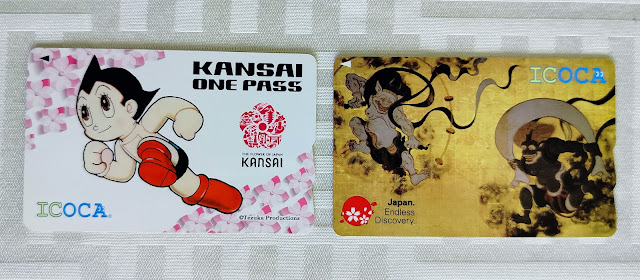
My ICOCA (left) which I have had since 2016,
and my father's ICOCA (right) which we bought on this trip.

If you don't have an ICOCA, you can still buy the ICOCA + Haruka ticket at the JR West Ticket Office. The ICOCA would cost 2000 JPY, which already includes 1500 JPY worth of credits. The ICOCA can be used for public transportation (trains, subways, buses, trams), lockers, vending machines, and convenience stores.

Although the website states that you could buy discounted Haruka tickets at other stations, I found it was not so. On our last day in Japan, we were going to buy our discounted Haruka ticket (Kyoto to Kansai Airport Station) at Kyoto Station, but the station staff said it was only for sale at Kansai Airport Station. It was such a bummer to pay 2730 JPY when I knew I could have paid only 1800 JPY had I known it was only for sale at Kansai Airport Station. Argh. So, if you have reached this far, I have one valuable tip for you: make sure to also buy your return ticket at Kansai Airport Station!

Monday, October 23, 2017

Kansai Diaries, Day 9: Osaka, Over and Out

December 1, 2016

Ah, the ninth and last day of my solo Kansai trip. Today I will be visiting two museums, one of which is in Toyonaka City, north of Osaka City, and I start my day early wanting to arrive at the Open Air Museum of Old Japanese Farmhouses as it opens. I use the 1-Day Osaka Visitor's Ticket  (can be used on Osaka's municipal subway, tram, and buses) that I had bought for 550 yen at Kansai Airport on the day I arrived.

I take the red line to Esaka Station (the last stop) and transfer to the Kita-Osaka Kyuko Railway. The automatic gate bars me from entering. Oops. My pass is not valid in this railway and I ask for help from the station attendant. Without her uttering a word in English, she helps me at the machine where I have to pay 90 yen for fare adjustment.


Nearest Station: 4-minute walk from Ryokuchikoen Station

I arrive at Hattori Ryokuchi Park, where the Open Air Museum of Old Japanese Farmhouses is located. It's a huge park. The size overwhelms me; I have to gather my wits about. As I wend my way through the park in the general direction of the museum, I observe a man sleeping on a bench, flower beds abloom, and a bunch of kids on a school outing.


I finally reach the museum. Students clad in suits are lingering outside. I—we are a few minutes early. Good, I can eat my breakfast on a nearby bench. By the time I come back the students have disappeared.


日本民家集落博物館
Tuesday to Sunday 930AM to 5PM
Admission fee: 500 yen

Nearest Station: 10-minute walk from Ryokuchikoen Station

Even as I pay for my ticket, I am already transported to the Edo period—the ticket office is a structure that used to be a village master's house in Osaka in said period. I am given a map of the 3.6 hectare museum. The map has houses numbered 1 to 12 and I switch my OC mode on: I visit the houses in numerical order.

The open air museum consists of twelve houses from the 17th to 19th century (Edo period) from different prefectures of Japan. These are not replicas but the real thing. These have been moved and restored from as far as Iwate in northern Japan and Kagoshima in southern Japan!

Farmhouse with thick thatched walls. This farmhouse is from a mountainous area in Nagano.

 A narrow farmhouse with wooden boards under the eaves to protect the house from wind and rain. This farmhouse is from a valley in Nara.

 A farmhouse with thick solid beams built for the snowy region in Fukui. 

Tearoom from Osaka

Rural kabuki theater from Kagawa

An elevated storehouse to protect the stored grain from humidity and mice. This structure is from Kagoshima.

A farmhouse with a steep roof called gassho-zukuri as it resembles hands pressed together in prayer. This farmhouse is from Gifu.

Rice granary from Osaka

Most of the houses can be entered and explored, and I take my time doing so. Some houses have earthen floors, some houses have rooms that are elevated, some houses are L-shaped, etc. The design of each house is dependent on the area it was built in. Really interesting.

By the time I reach the fourth house, I see two local visitors. Like the students, they are also in suits...and I think to myself 'It must be nice to be able to take a break in between office hours and explore your local park.'

As I follow my map and visit houses, I find groups of students, those I had seen waiting outside the museum earlier, scattered about. Two or three are busy sketching, others are exploring the interiors, others are listening to a local guide, others are having a conversation with the two local visitors in suits I had seen at the fourth house.

I cross paths with them several times and as I leave the open air museum, I think 'Will our paths ever cross again?' And I laugh at the absurdity of it. Osaka is too large.


大阪くらしの今昔館
Wednesday to Monday 10AM to 5PM
Admission fee: 600 yen

Nearest Station: Tenjimbashisuji6-chome Station

Exit 3 of Tenjimbashisuji6-chome Station goes straight to the building where the Osaka Museum of Housing and Living is. The museum entrance is on the 8th floor. I am given a 100-yen discount thanks to my Osaka Visitor's Ticket, and a free audio guide (regular price of 100 yen) and a museum map thanks to my Kansai One Pass. But first I have to leave my backpack in a locker.

After stuffing my bag in a locker, I am told to go to the 10th floor where I see rooftops through a glass window. These aren't rooftops of the buildings outside, but rooftops of the buildings inside the museum.

Rooftops seen from the 10th floor

The buildings on the 9th floor are what one would find in Osaka in the 1830's: a bath house, a town meeting hall, an apothecary, shops selling dolls, books, fabrics, etc, and tenement houses. There are visitors in kimono adding to the ambience of the museum.

Visitors can explore any which way they like (some areas have printouts visitors can read and keep), but with my audio guide and map, I again turn on my OC mode and follow the map. The audio guide gives me insight about life in Osaka in the 1800s. As I go from bath house to shop to town hall to house, the museum lighting changes from day to night and back to day—time inside the museum moves faster than my watch.

1830s Osaka

Doll shop

Bookshop

Inside the bookshop

A kitchen

Apothecary

Drinking well shared by tenement houses

The museum route leads me back to the 8th floor where there are dioramas showing how Osaka evolved from 1868 to 1950. I am fascinated by the teeny tiny details of the dioramas.


 Festival

Osaka had trailer homes!

Barber shop

Luna Park, an amusement park in Osaka in 1912

My trip through time ends and I go back to the bank of lockers to take out my backpack. I shut the locker door and spot a large group of students in suits. Seems like it's a popular day for field trips. And then I see a familiar face: one of the two men in suits I had seen at the open air museum. It dawns on me: they are teachers out on a school trip with their students. He does a double take as he recognizes my face. I could see he wants to laugh. I hold my laughter in. Instead, I grin, say hello, and hurry into the empty elevator where I laugh out loud.


黒門市場

Nearest Station: Nippombashi Station

It's past lunch time and I am hungry. Not a good idea to visit a market, but I go to Kuromon Market (Kuromon Ichiba), six stops away, anyway. I am sure I won't see them again. This place has nothing to do with houses. But has everything to do with food! (If I do see them again, I am sure I will burst into laughter right in their faces.)

I enjoy looking at food. I especially enjoy tasting food. But not now. I just take a stroll around the market and check out the displays of fresh seafood, vegetables, and fruits (I want to try the white strawberries but it is wayyyy too expensive!).


3-8-25 Nihonbashi, Naniwa-ku, Osaka
11AM to 8PM

The fresh but all too expensive seafood I saw in the market was making my stomach rumble. I leave the market and check out my pinned places on my Google map. Aha! I see Cafe Gram a few minutes walk away! Those facebook videos of fluffy pancakes I will now see (and eat!) for myself!

Cafe Gram is on the second floor. It is quiet; only one table is occupied. A sign on the counter says the Premium Pancakes (yup, the fluffy pancakes) are limited. Luckily, it is available and I order it despite it being too expensive in my opinion (950 yen for pancakes!). It's my last day in Osaka anyway.


Premium Pancakes


This article is now available as a mobile app. Go to GPSmyCity to download the app for GPS-assisted travel directions to the attractions featured in this article.


Japan
Know Before You Go
Single Entry Tourist Visa for Japan
Roam Around Japan with a Swagger
An Ignoramus in Japan: Vending Machines
An Ignoramus in Japan: Bathrooms and Toilets
An Ignoramus in Japan: Manhole Covers
I Spy With My Little Eye: Japan's Fashion Contradictions
I Spy With My Little Eye: On the Go in Japan

Kansai Diaries (2016)
9D/9N | Wakayama, Nara, Kyoto, Osaka
UNESCO World Heritage Sites in the Kansai Region
Osaka: Day 0: Arrival
Osaka Accommodations: Hotel Raizan, Hotel Mikado
Wakayama: Day 1: Going to, Sleeping in, and Eating in Koyasan
Wakayama: Day 1.5: West Side of Koya Town
Wakayama: Koyasan Sidewalk Shorts
Wakayama: Days 1.75~2: Okunoin, Three Times
Nara: Sleep, Eat, and Explore Nara City
Nara: Day 3: Horyuji, Hokkiji, and some Japanecdotes in Ikaruga Town
Nara: Day 3.5: Yakushiji, Toshodaiji, and Heijo Palace Site in Nara City
Nara: Day 4: Early Morning at Nara Park
Nara: Day 4.25: Naramachi Walking Tour
Nara: Day 4.5: Yoshiki-en, Todaiji, and Kofukuji in Nara Park
Kyoto Accommodations: Guesthouse Wind Villa, Shiori Yado
Kyoto: Day 5: Rainy Day in Uji City
Kyoto: Day 5.5: Tofukuji, Kawai Jinja, Shimogamo Jinja
Kyoto: Day 6: Ginkakuji, Ryoanji, Ninnaji
Kyoto: Day 6.75: Gion Night Walking Tour
Kyoto: Day 7: All Day in Arashiyama
Kyoto: Day 8: Last Day in Kyoto
Osaka: Day 8.75: Dizzying Dotonbori
Osaka: Day 9: Osaka, Over and Out (you're here!)

Saturday, October 21, 2017

Kansai Diaries, Day 8.75: Dizzying Dotonbori

November 30, 2016
Around 7pm, maybe

After checking in and settling in my room in Hotel Mikado, I debated with myself whether to grab dinner from a nearby convenience store or to go to Osaka's kitchen: Dotonbori. The thought of it being my last night in Osaka, thus the last chance to see Dotonbori at night, propelled me to the nearest subway station.

It was just a 4-minute ride from Dobutsuen-mae Station to Namba Station, but when I stumbled out of Namba Station, I was dizzy with hunger. Exacerbated by the wall of people that greeted me when I turned the corner to Dotonbori. I almost did a 180-degree turn and marched away. But the lights beyond the 100-deep people magnetized me and I squeezed my way through.

Upon seeing this, I almost made a 180-degree turn and marched away

The lights and the giant signboards all around gave me a jolt of energy and I momentarily forgot about my hunger, and did not mind weaving and dodging the human obstacles around me. There was a giant crab, humongous gyoza, a big floating pufferfish, a massive scallop, etc.


 Giant crab

 
 Humongous gyoza, and a large, pink octopus

 
 Big floating pufferfish, and a massive scallop

But then the medley of smells wafting from all directions reminded me that I was here to eat. I know I should find a busy restaurant with a queue of customers because that means the food is good, but I was too hungry to wait in line. I veered to the right, to a less busy street, and found myself entering Hanamaruken. The ramen is supposed to be really good here, but I decided to order just chahan (Japanese fried rice) and gyoza (dumplings).

Hanamaruken

Chahan, gyoza, and soup

After dinner, I got out into the chilly night to find the Glico Man for an obligatory tourist photo, and then walked off my dinner along Dotonbori River.

 Glico Man

Dotonbori River


Japan
Know Before You Go
Single Entry Tourist Visa for Japan
Roam Around Japan with a Swagger
An Ignoramus in Japan: Vending Machines
An Ignoramus in Japan: Bathrooms and Toilets
An Ignoramus in Japan: Manhole Covers
I Spy With My Little Eye: Japan's Fashion Contradictions
I Spy With My Little Eye: On the Go in Japan

Kansai Diaries (2016)
9D/9N | Wakayama, Nara, Kyoto, Osaka
UNESCO World Heritage Sites in the Kansai Region
Osaka: Day 0: Arrival
Osaka Accommodations: Hotel Raizan, Hotel Mikado
Wakayama: Day 1: Going to, Sleeping in, and Eating in Koyasan
Wakayama: Day 1.5: West Side of Koya Town
Wakayama: Koyasan Sidewalk Shorts
Wakayama: Days 1.75~2: Okunoin, Three Times
Nara: Sleep, Eat, and Explore Nara City
Nara: Day 3: Horyuji, Hokkiji, and some Japanecdotes in Ikaruga Town
Nara: Day 3.5: Yakushiji, Toshodaiji, and Heijo Palace Site in Nara City
Nara: Day 4: Early Morning at Nara Park
Nara: Day 4.25: Naramachi Walking Tour
Nara: Day 4.5: Yoshiki-en, Todaiji, and Kofukuji in Nara Park
Kyoto Accommodations: Guesthouse Wind Villa, Shiori Yado
Kyoto: Day 5: Rainy Day in Uji City
Kyoto: Day 5.5: Tofukuji, Kawai Jinja, Shimogamo Jinja
Kyoto: Day 6: Ginkakuji, Ryoanji, Ninnaji
Kyoto: Day 6.75: Gion Night Walking Tour
Kyoto: Day 7: All Day in Arashiyama
Kyoto: Day 8: Last Day in Kyoto
Osaka: Day 8.75: Dizzying Dotonbori (you're here!)
Osaka: Day 9: Osaka, Over and Out

Tuesday, July 25, 2017

Kansai Diaries, Day 0: Arrival

November 22, 2016
Tuesday
7:55 PM

Touchdown Kansai International Airport. I follow my fellow passengers out of the plane, into the train that would transport us to the main building, and tail them through the airport hallways until we reach Immigration.

The queue at Immigration isn't long. Either our flight's the only one that arrived within the last 15 minutes or so, or their immigration procedure is really efficient. The immigration officer stamps me through and smilingly informs me that I could stay for 30 days (how I wish my wallet and I could!). Immigration, baggage claim, and into the Arrivals Lobby in just a few minutes (ah, yes, they are extremely efficient).

Before proceeding to find the train that will take me to Osaka, I search and find the Tourist Information Booth where I collect some brochures and buy an Osaka Visitors' Ticket, a ticket for unlimited rides on Osaka's municipal subway, tram, and buses, which I plan to use on my the last day of my trip. Why buy it this early? So that I wouldn't have to go and hunt for the Tourist Information Center in Shinsaibashi in Osaka City.


I mentally go through my things to do and still have two items on my list: (1) buy a Koyasan World Heritage Ticket to be used the next two days, and (2) buy a Kansai One Pass, an IC transportation card to be used for getting around Kansai. I buy these two at the Nankai Airport Station. The man at the counter asks me questions (Koyasan World Heritage Ticket? How many? For when?) and repeats them, making sure we understand each other correctly. I pay and thank him and carefully stuff my Koyasan World Heritage Ticket in my bag and hold my Kansai One Pass, ready for its first use on the Nankai Airport Express to Osaka City's Shin-Imamiya Station.

I arrive in Shin-Imamiya Station in 45 minutes and soon I am rolling my bag along the dingy but clean sidewalks of Osaka, passing by wobbly drunk gentlemen, towards tonight's accommodation: Hotel Raizan. I check in and find my room at the end of the hallway on the nth floor. I take snapshots of my tidy tiny room and send it to my family WhatsApp group, letting them know I have arrived safe and sound.

My little room in Hotel Raizan


Japan
Know Before You Go
Single Entry Tourist Visa for Japan
Roam Around Japan with a Swagger
An Ignoramus in Japan: Vending Machines
An Ignoramus in Japan: Bathrooms and Toilets
An Ignoramus in Japan: Manhole Covers
I Spy With My Little Eye: Japan's Fashion Contradictions
I Spy With My Little Eye: On the Go in Japan

Kansai Diaries (2016)
9D/9N | Wakayama, Nara, Kyoto, Osaka
UNESCO World Heritage Sites in the Kansai Region
Osaka: Day 0: Arrival (you're here!)
Osaka Accommodations: Hotel Raizan, Hotel Mikado
Wakayama: Day 1: Going to, Sleeping in, and Eating in Koyasan
Wakayama: Day 1.5: West Side of Koya Town
Wakayama: Koyasan Sidewalk Shorts
Wakayama: Days 1.75~2: Okunoin, Three Times
Nara: Sleep, Eat, and Explore Nara City
Nara: Day 3: Horyuji, Hokkiji, and Some Japanecdotes in Ikaruga Town
Nara: Day 3.5: Yakushiji, Toshodaiji, and Heijo Palace Site in Nara City
Nara: Day 4: Early Morning at Nara Park
Nara: Day 4.25: Naramachi Walking Tour
Nara: Day 4.5: Todaiji, Yoshiki-en, and Kofukuji in Nara Park
Kyoto Accommodations: Guesthouse Wind Villa, Shiori Yado
Kyoto: Day 5: Rainy Day in Uji City
Kyoto: Day 5.5: Tofukuji, Kawai Jinja, Shimogamo Jinja
Kyoto: Day 6: Ginkakuji, Ryoanji, Ninnaji
Kyoto: Day 6.75: Gion Night Walking Tour
Kyoto: Day 7: All Day in Arashiyama
Kyoto: Day 8: Last Day in Kyoto
Osaka: Day 8.75: Dizzying Dotonbori
Osaka: Day 9: Osaka, Over and Out

Sunday, July 23, 2017

Itinerary and Expenses: 9 Days of Nerdiness in Kansai

I'll tell you a secret. I fell in love sometime in my 10-day Japan trip in autumn of 2015. I had a quick love affair with Ainokura Village in Toyama Prefecture and I fell madly and totally in love with Kyoto. I fell in love and I promised I'd go back for another visit.

381 days later, I was back in the arms of Japan. This time I made like a gentleman and took it slow; I did not bolt through cities like what my friends and I did in 2015. I stayed in the Kansai Region for nine days, stepping foot in just four (Wakayama, Nara, Kyoto, and Osaka) of seven prefectures (the other three are Hyogo, Mie, Shiga).


Since I was traveling alone, I went all out in nerdiness, visiting temples, shrines, and historical places, and, most importantly, as many UNESCO World Heritage Sites in the Kansai Region that time and distance would allow.

In planning out my itinerary, I tried to keep within the same budget as my 2015 trip: an average of Php 4500 per day for accommodation, food, transportation, and admission fees.

This trip happened late November 2016 with the exchange rate at 0.465 PHP for every 1 JPY

Accommodation. Like my 2015 trip, I set aside Php 1500 a night for accommodation, for a total of Php 13,500 for 9 nights (about 29,000 yen with an exchange rate of 0.465). In Osaka, the cheapest hostel I found was 1100 yen a night, but I eventually settled for a single room (though bathrooms were shared) in business hotels, which cost me 2500 yen (less than Php 1200) per night. In Koyasan, I wanted to try the temple stay, but it was way beyond my budget (temple stay would cost at least 9,700 yen a night, with breakfast and dinner), so I settled for the only guesthouse in town, Koyasan Guesthouse Kokuu, where a capsule space costs 3500 yen a night. Nara and Kyoto hostels were a bit more expensive compared to Osaka (dorm beds would cost an average of 2500 yen a night; whereas in Osaka, 2500 yen could already be a single room), but still within my budget. If you're comfortable staying at hostel dorm rooms, set aside a budget of at least 2500 yen per night (some can cost up to 3800 yen a night, depending on the area).

Transportation. Neither the JR Pass nor the JR Kansai Area pass was beneficial to my itinerary. Instead, to get around, I paid the regular fare using the Kansai One Pass (only for tourists), an ICOCA or IC transportation card that could be used in various train/subway lines in the Kansai area. Although this did not offer fare discounts, it did provide convenience. Rather than buying a ticket every time I had to ride the train/subway, I could just tap the card at the turnstiles (provided, of course, I had enough credits in the card). The Kansai One Pass also offered discounts/benefits at various tourist sites. For traveling within the city, I took advantage of unlimited ride passes such as Koyasan World Heritage Ticket, Nara bus pass, Kyoto bus pass, and Osaka Visitor's Ticket (for Osaka municipal subways/buses/tram only). I planned out my route in advance to make the most of these unlimited ride passes.

Food. I spent an average of 2,200 yen a day for 3 meals, snacks, and drinks. It was a good mix of convenience store boxed meals (400 to 600 yen), set meals from donburi shops (450 to 1000 yen), and restaurants (meals from 1100 to 1500 yen). For Japan, I advice to budget at least 3,000 yen per day for food.

Admission fees. There are temples, shrines, parks, gardens that can be entered for free. Most though would charge an admission fee (from 200 to 1500 yen). Some transportation passes offer discounted admission fees to some tourist attractions (expenses marked with an asterisk in the above table are discounted rates). The Koyasan World Heritage Ticket came with 20% discount coupons for Kongobuji, Kondo Hall, Konpon Daito Pagoda, and Reihokan Museum. The Kansai One Pass offered discounts/benefits to many attractions around the Kansai area, but I only used it at Monkey Park Iwatayama in Kyoto (100 yen discount) and Osaka Museum of Housing and Living (free audio guide rental worth 100 yen). With the Osaka Visitor's Ticket, I was also able to get a 100 yen discount on the admission fee for the Osaka Museum of Housing and Living.

Pocket WiFi. It was important that I had a pocket WiFi for this trip. Luckily, Flytpack sponsored me for the entire duration of the trip. If not, it would have cost me about Php 3000 for the 9 days rent of their pocket WiFi plus courier fees.

Plane ticket. Like all my other posts about trip expenses, I did not include the plane ticket, because the ticket cost would depend on where you're coming from and which international airport in Japan you wish to start/end your journey in. But since this post is about Kansai, I will tell you that I flew in and out of Kansai International Airport in Osaka via a budget airline, with a connection in Manila. Much as I wanted to fly direct to Osaka from Cebu, I found it too expensive. The regular roundtrip ticket for the direct flight would cost around Php 22,000 (on sale it would cost at least Php 13,000).


Japan is the most expensive country in Asia that I have traveled to, but with a bit of planning and research, a trip to Japan need not break the bank. Fewer number of days and concentrating on just one or two nearby cities, of course, will cost less. But, I warn you, once you visit Japan, you will want to keep coming back!


Japan
Know Before You Go
Single Entry Tourist Visa for Japan
Roam Around Japan with a Swagger
An Ignoramus in Japan: Vending Machines
An Ignoramus in Japan: Bathrooms and Toilets
An Ignoramus in Japan: Manhole Covers
I Spy With My Little Eye: Japan's Fashion Contradictions
I Spy With My Little Eye: On the Go in Japan

Kansai Diaries (2016)
9D/9N | Wakayama, Nara, Kyoto, Osaka (you're here!)
UNESCO World Heritage Sites in the Kansai Region
Osaka: Day 0: Arrival
Osaka Accommodations: Hotel Raizan, Hotel Mikado
Wakayama: Day 1: Going to, Sleeping in, and Eating in Koyasan
Wakayama: Day 1.5: West Side of Koya Town
Wakayama: Koyasan Sidewalk Shorts
Wakayama: Days 1.75~2: Okunoin, Three Times
Nara: Sleep, Eat, and Explore Nara City
Nara: Day 3: Horyuji, Hokkiji, and Some Japanecdotes in Ikaruga Town
Nara: Day 3.5: Yakushiji, Toshodaiji, and Heijo Palace Site in Nara City
Nara: Day 4: Early Morning at Nara Park
Nara: Day 4.25: Naramachi Walking Tour
Nara: Day 4.5: Todaiji, Yoshiki-en, and Kofukuji in Nara Park
Kyoto Accommodations: Guesthouse Wind Villa, Shiori Yado
Kyoto: Day 5: Rainy Day in Uji City
Kyoto: Day 5.5: Tofukuji, Kawai Jinja, Shimogamo Jinja
Kyoto: Day 6: Ginkakuji, Ryoanji, Ninnaji
Kyoto: Day 6.75: Gion Night Walking Tour
Kyoto: Day 7: All Day in Arashiyama
Kyoto: Day 8: Last Day in Kyoto
Osaka: Day 8.75: Dizzying Dotonbori
Osaka: Day 9: Osaka, Over and Out

Thursday, July 13, 2017

An Ignoramus in Japan: Manhole Covers

There are so many interesting things to see in Japan. Even the manhole covers! There are over 6000 manhole cover designs and I have only seen 0.30% of that number! (Some I missed to take a photo of, but have found photos of them thanks to citizens of the internet world!) Designs usually include the city/town's crest/seal/emblem, official flower/tree, and/or local spots.


Spotted in: Shinjuku Ward, Tokyo

This manhole cover is adorned with two of Tokyo's symbols:
somei-yoshino cherry blossom and ginkgo biloba tree.
Let's learn Kanji:
東京 Tokyo
下水道 (gesuido) sewer
合流 (goryu) confluence


TOKYO
Spotted in: Shibuya Ward, Tokyo

And this here is none other than Hachiko!
Saw this by the Hachiko Memorial Statue outside Shibuya Station.


Spotted in: Ainokura Village, Nanto City, Toyama

On this manhole cover are azalea (flower) and paulownia (tree), the symbols of the former village of Taira, to which Ainokura belonged to. In 2004, four towns and four villages (including Taira Village) merged into what is now called Nanto City. This manhole was constructed before the merging. (Thanks to Gokayama Tourist Information Center for providing information about this design! I couldn't find it on any website.)
Let's learn Kanji:
排 (hai) drain
Photo by そらみみ via Wikimedia Commons


Spotted in: Himeji City, Hyogo

Himeji City's manhole covers are decorated with the white heron and the orchid Pecteilis radiata (also known as White Egret Flower). These two are symbols of the city.
Let's learn Kana (Kanji and Hiragana):
消火栓 (shokasen) fire hydrant 
ひめじ Himeji

Let's learn Hiragana:
ひめじ Himeji
おすい (osui) sewage


Spotted in: Miyajima/Itsukushima, Hiroshima

On the center of this manhole cover in Miyajima is the island's seal/emblem.
Let's learn Kanji:
汚水 (osui) sewage
Photo by そらみみ via Wikimedia Commons

And why the maple leaves on this drain cover? Because the maple is Hiroshima prefecture's tree.
Let's learn Kanji:
広島県 (Hiroshima-ken) Hiroshima Prefecture + 木 (ki) tree


Spotted in: Chuo Ward, Osaka City, Osaka

On this manhole cover are Osaka City's seal/emblem, the city's tree (cherry tree), and Osaka Castle.
Let's learn Kanji:
中央区 (Chuo-ku) Chuo Ward

And this one shows some of the city's tourist attractions: Tombori river cruise, Dotonbori Canal, Osaka Castle, and...I don't know what the two buildings are. If you know, please leave a comment.
Let's learn Kanji:
大阪市 (Osaka-shi) Osaka City
空気弁 (kuki-ben) air valve
水道局 (suidokyoku) Waterworks Bureau


Spotted in: Toyonaka City, Osaka

Toyonaka City's manhole cover has roses (the city's flower) and a crocodile. Because crocs live in the city's sewers! Just kidding! The crocodile is Osaka University's official mascot Machikane-wani or Dr. Wani, named after the huge crocodile fossil discovered in 1964 in Osaka University's Toyonaka campus.
Let's learn Hiragana:
とよなか Toyonaka


Spotted in: Koya Town, Wakayama

On the center of this manhole cover is Koya Town's emblem.
Let's learn Kanji:
汚水 (osui) sewage
Photo from Japan Visitor


Spotted in: Nara City, Nara

Nara is known for its more than 1,000 free-roaming deer in Nara Park, thus the deer on the manhole cover. The design also includes the city's flower, yaezakura (a variety of cherry blossom), and the city's emblem in the center.
Let's learn Kanji:
汚水 (osui) sewage


Spotted in: Ikaruga town, Nara

On Ikaruga Town's manhole cover are the Japanese black pine (the town's tree), camellia sasanqua (the town's flower), and Hokkiji (a UNESCO World Heritage Site located in Ikaruga Town).
Let's learn Hiragana:
いかるが Ikaruga
げすい (gesui) sewage

Colored version from Muza-chan's Gate to Japan


Spotted in: Kyoto City, Kyoto

I saw three different manhole cover designs in Kyoto City. All three have a simple patterned design with Kyoto City's crest on the center.


Spotted in: Uji City, Kyoto

In Uji City, I spotted two manhole covers that, like Kyoto City's covers, are designed with a pattern surrounding the city's emblem.

An interesting find was a colorful drain with Japanese globeflowers, Uji City's flower.
Let's learn Kana (Kanji and Hiragana):
市の花 (ichi no hana) City flower
やまぶき (yamabuki) Japanese globeflower

Another interesting find in Uji City was a manhole cover with maple (the city's tree) leaves, and Ujibashi (bridge), one of the most ancient bridges in Japan.
Let's learn Kanji:
宇治市 (Uji-shi) Uji City
汚水 (osui) sewage

Let's learn Kanji:
消火栓 (shokasen) fire hydrant


YAMANASHI
Spotted in: Fujikawaguchiko, Yamanashi

And here's one from my friend, Bunny, who visited Fujikawaguchiko recently. Thanks, Bunny! On this manhole cover are oenothera (the town's flower) and, on the center, the town's symbol.

Let's learn Hiragana:
おすい (osui) sewage

Have you seen any interesting manhole covers in Japan? Do send me a photo and its location and I will add it in this blogpost. Thank you, fellow drainspotter!


Japan
Know Before You Go
Single Entry Tourist Visa for Japan
Roam Around Japan with a Swagger
An Ignoramus in Japan: Vending Machines
An Ignoramus in Japan: Bathrooms and Toilets
An Ignoramus in Japan: Manhole Covers (you're here!)
I Spy With My Little Eye: Japan's Fashion Contradictions
I Spy With My Little Eye: On the Go in Japan

From Tokyo to Hiroshima (2015)
10D/9N | Tokyo, Toyama, Kyoto, Hyogo, Osaka, Hiroshima
Tokyo Accommodation: Shinjuku Airbnb
Tokyo: Memorable Tokyo Eats
Tokyo: Odaiba
Tokyo: Doing Touristy Things in Tokyo
Toyama: A Hamlet Called Ainokura
Kyoto Accommodation: K's House Hostel Kyoto
Kyoto, Japanecdote: Wisdom from the Road: On exits #2
Kyoto: By the Thousands (Kyoto Imperial Palace, Sanjusangendo, Fushimi Inari Taisha, Arashiyama Bamboo Grove)
Kyoto, Japanecdote: Turning Japanese
Kyoto: Braving the Crowds at these UNESCO World Heritage Sites in Kyoto (Kiyomizu-dera, Nijo Castle, Kinkakuji)
Hyogo, Japanecdote: If Only I Could Speak Nihongo
Hyogo: Day Trip to Himeji: Himeji Castle and Shoshazan Engyoji Temple
Hyogo, Japanecdote: Am I an Alien?
Hiroshima: Strolling and Snacking in Miyajima
Hiroshima: Remembering the Past in Hiroshima
Osaka, Japanecdote: How to Lose Friends
Osaka Accommodation: Osaka Airbnb
Osaka, Japanecdote: Where is Bentencho Station?
Osaka: Osaka Adlaw, Osaka Ako sa Osaka
Osaka, Japanecdote: Learn From Your Mistakes

Kansai Diaries (2016)
9D/9N | Nov 2016 | Wakayama, Nara, Kyoto, Osaka
UNESCO World Heritage Sites in the Kansai Region
Osaka: Day 0: Arrival
Osaka Accommodations: Hotel Raizan, Hotel Mikado
Wakayama: Day 1: Going to, Sleeping in, and Eating in Koyasan
Wakayama: Day 1.5: West Side of Koya Town
Wakayama: Koyasan Sidewalk Shorts
Wakayama: Days 1.75~2: Okunoin, Three Times
Nara: Sleep, Eat, and Explore Nara City
Nara: Day 3: Horyuji, Hokkiji, and Some Japanecdotes in Ikaruga Town
Nara: Day 3.5: Yakushiji, Toshodaiji, and Heijo Palace Site in Nara City
Nara: Day 4: Early Morning at Nara Park
Nara: Day 4.25: Naramachi Walking Tour
Nara: Day 4.5: Todaiji, Yoshiki-en, and Kofukuji in Nara Park
Kyoto Accommodations: Guesthouse Wind Villa, Shiori Yado
Kyoto: Day 5: Rainy Day in Uji City
Kyoto: Day 5.5: Tofukuji, Kawai Jinja, Shimogamo Jinja
Kyoto: Day 6: Ginkakuji, Ryoanji, Ninnaji
Kyoto: Day 6.75: Gion Night Walking Tour
Kyoto: Day 7: All Day in Arashiyama
Kyoto: Day 8: Last Day in Kyoto
Osaka: Day 8.75: Dizzying Dotonbori
Osaka: Day 9: Osaka, Over and Out