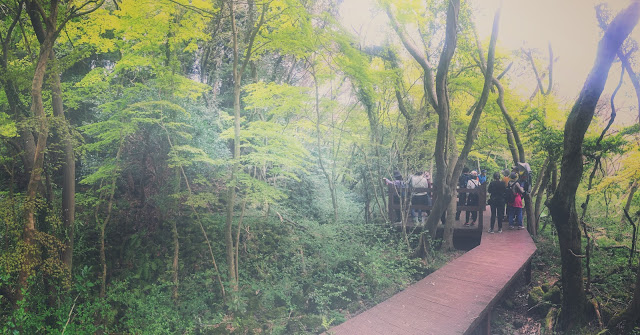
Saturday, June 15, 2019

Jeju Olle: Udo Island

Jeju Olle is a series of trails that goes around Jeju Island plus trails around some surrounding islands—a total of 26 trails. If you hiked all 26 trails, then you would have traveled on foot 425 kilometers! Since I did not have the time (and, surely, not the energy) to do all 26 trails, I just picked two. And these two are trails that are not on Jeju Island but trails that go around two of its nearby islands: Udo Island and Gapado Island.

Udo Island was recommended by Annie, a Chinese girl (I don't know her Chinese name; she just called herself Annie) I met during my first visit to Jeju Island in the spring of 2018. I wasn't really keen on visiting Udo Island, but when I found that there was an Olle trail that goes around Udo, it went straight to my Spring 2019 itinerary.

Spring 2019 came and I was excited to finally be able to hike a Jeju Olle trail. But first we (I was traveling with a friend) had to get to Udo Island.

Approaching Udo Island

Getting to Udo Island. We took Bus 211 from Jeju City to Seongsan Port (1.5 hours, 1150 krw). At Seongsan Port, we bought roundtrip ferry tickets (8500 krw, roundtrip, per person) to Cheonjin Port in Udo Island. The ferry runs every half hour from 730am to 6pm (last trip schedule depends on the month; the last trip could be as early as 5pm in winter) and the journey takes only 15 minutes. (What surprised me about the ferry is that there are no seats. Everyone took off their shoes and found a spot on the floor to sit on. Of course, we followed suit.)

No chairs in the ferry

Getting around Udo Island. Outside Cheonjin Port in Udo Island were rental shops for bicycles, tandem bicycles, three-wheeled scooters, and motorcycles—options to get around the island, aside from walking or taking the shuttle bus.

My friend wanted to rent the cute three-wheeled scooters, but a passport and international motorcycle driver's license were required to rent a scooter or motorcycle. I was actually glad we couldn't rent (neither of us had an international motorcycle driver's license) because my main purpose in visiting Udo Island was to hike!

Cute three-wheeled scooters

You can also rent a bike or a tandem bike to get around Udo

Hiking around Udo. Jeju Olle Route 1-1 is a trail that circumnavigates Udo Island. The trail is 11.3 kilometers long and takes 4 to 5 hours to complete. Difficulty level is classified as medium. The trails are marked by blue and red ribbons, arrows (blue or orange; follow orange arrows if you are going in the reverse direction), and Ganse (horse-shaped trail markers; the head points in the direction of the route).

Blue and red ribbons as trail markers

We followed the trail in the counterclockwise direction. Just a few minutes of walking (and a bit of uphill walking) brought us to Udo-bong (Udo Peak) and Udo Lighthouse. From Udo Peak we could see Seongsan Ilchulbong, a tuff cone (and a UNESCO World Heritage Site), in the distance. In the other direction, the vast sea. I wonder if, on a clear day, we could see Japan?

The wind up at the peak (which wasn't high at all, just 132.5 masl) and the wide open views were refreshing.

On our way to Udo Peak, we saw a horse and this cute little building

Seongsan Ilchulbong (far left in the background) can be seen from Udo-bong (Udo Peak)

Udo Lighthouse


When we descended the peak we passed houses, and so many fields of canola, of rye, and of barley. Most of the time, it was just us hiking. (We only saw a group of three hikers at the beginning of the trail. The rest of the trail, it was just me and my friend.) At one point, we followed overgrown paths between low stone walls that made us doubt if we were on the right path. There was also a time when we crossed fields with nary a soul in sight and we hoped and prayed no one would pop out and shoot us for trespassing.

Canola field

It was a beautiful day for a hike

Is this the right path?

Halfway along the trail, we reached Hagosudong Beach, where we found a bunch of restaurants just across. Just in time for lunch! 

Hagosudong Beach

We ate lunch at 로뎀가든 Rothem Garden. The menu was in Korean, so we just ordered their recommendation: 흑돼지주물럭 Black Pork Stew (30000 krw for 2 persons). It looked like everyone else was having it, so it must be good. And, yes, it was deliciously spicy! After eating, we spied one table having rice with egg and cheese (a little research told me it was 우도한라산볶음밥 Hallasan Fried Rice). It looked pretty good too, but we were too full to try that one.

Black Pork Stew at Rothem Garden, a restaurant facing Hagosudong Beach

After lunch, we jumped right back to hiking. We followed the rest of the trail, passing by more houses and fields. Sometimes the trail was on dirt paths, other times it just followed an asphalt road—rarely a major one since we scarcely saw cars.

We reached Cheonjin Port, the start and end point of the trail, after 4.5 hours of leisurely walk with many stops in between. Since we had time to spare before going back to Jeju Island, we rewarded ourselves with peanut ice cream (5000 krw) at Cafe 콩리.

Peanut ice cream

Would I recommend hiking Udo Island (Olle Route 1-1)? If you have time to spare and enjoy taking long, easy walks on mostly flat land (the only uphill section was going to Udo Peak/Udo Lighthouse), then, yes, go for it! But only on the cooler months. Hiking in summer might not be a good idea since there is no tree cover all throughout the route. (If you insist on hiking in summer, I have a strong feeling you will be able to eat a gallon of peanut ice cream after the hike.)


Jeju and Busan, April 2019
Jeju Accommodation: Jeju R Hotel & Guesthouse
Traveling Around Jeju by Bus Plus KakaoMap (2019)
Eats from Jeju City Restaurants I Can't Read the Names Of
Jeju City Lights: Iho Tewoo Beach and Jeju Light Art Festa
Geomun Oreum and Manjanggul Lava Tube
Art and Nature in Seogwipo City
Jeju Olle: Udo Island (you're here!)
Jeju Olle: Gapado Island
Busan Accommodation: One Way Guesthouse
Where and What We Ate in Busan

Thursday, June 13, 2019

Art and Nature in Seogwipo City

Jeju City was our home base for the six days we were in Jeju, but we did not confine ourselves within its boundaries. We ventured south to Seogwipo City, just an hour and a half by bus (we took Bus 281, 1150 krw per way), for some art and nature.

Lee Jung Seop Gallery/Residence/Street

In 2018, a drawing on a piece of foil captured my attention in Busan Museum of Art, and the artist's name—Lee Jung Seop—stuck in my brain. Lee Jung Seop spent the year 1951 in Seogwipo City, and the city has dedicated a street to him. On this street is the house he lived in and an art gallery of his works.

Lee Jung Seop Street
이중섭거리

📍 Google Map

Lee Jung Seop Street (and the alleys branching from it) is, not surprisingly, full of art, be it on the walls or on the ground.


Lee Jung Seop Gallery
이중섭미술관

27-3 Ijungseop-ro, Seogwipo-si
Tuesday to Sunday 9AM to 6PM
Admission fee 1500 krw
📍 Google Map

The Lee Jung Seop Gallery has two floors. On the first floor is the permanent exhibit of Lee Jung Seop's life and artworks, and a gift shop. I was most fascinated by Lee Jung Seop's art on foil.


On the second floor is a changing exhibit. Because 2019 (the year we visited) was the year of the pig, it showcased pig-themed artworks.


Lee Jung Seop Residence
이중섭 거주지

29 Ijungseop-ro, Seogwipo-si
📍 Google Map

During WWII, Lee Jung Seop and his family (he had a Japanese wife and two sons) fled the war and stayed in Seogwipo City in 1951 where they lived in a room in a house owned by Song Tae Ju and Kim Soon Bok. Now, the house is open to the public and is free to view.


Seogwipo Street Art

While wandering around Seogwipo City, we met an elderly man on the street who asked where we were from and where we wanted to go. He was quite happy to know we were foreigners and gave us directions (though we did not ask)—I guess he was just excited to have the chance practice his English. I am not sure we even followed his directions—we were too busy noticing so many random street art on walls of shops, houses, restaurants. And even on a bench.


Natural Wonders in Seogwipo

Seogwipo is gifted with wonderful nature, including Jeju's top three waterfalls and a cliff made of volcanic pillars.

Jeongbangpokpo (Jeongbang Falls)
정방폭포
37 Chilsimni-ro 214beon-gil, Seogwipo-si
Daily 9AM to 6PM
Admission fee 2000 krw
📍 Google Map

One of Jeju's top three waterfalls is Jeongbang Falls, just 600 meters east of Lee Jung Seop Street. Jeongbang is a 23-meter waterfall that falls directly to the sea. (Though I have read about waterfalls that fall directly to the sea, this is the first that I have seen such, not just on paper or on video!) Because Jeongbang's pool is surrounded by rocks, we were able to get near the falls, but not too near that we'd get drenched.


The sea facing Jeongbang Falls


Cheonjiyeonpokpo (Cheonjiyeon Falls)
천지연폭포

Cheonji-dong, Seogwipo-si
Daily 9AM to 10PM
Admission fee 2000 krw
📍 Google Map

The other two waterfalls included in Jeju's top three are Cheonjiyeon Falls and Cheonjeyeon Falls. Did you have to read it again to make sure you read it correctly? No, that is not an error. Really, those are the names! I only went to Cheonjiyeon Falls as it was only an 8-minute (700 meters) walk west of Lee Jung Seop Street (Cheonjeyeon Falls is an hour away by bus).

Cheonjiyeon Falls, at 22 meters, is almost as tall as Jeongbang Falls. And to see its beauty is a walk in the park. Literally. From the ticket booth, we crossed a bridge, passed souvenir shops, and followed a concrete path running alongside a river which is the habitat of nocturnal giant mottled eels. It was a pleasant 6-minute walk with lots of tree cover.


On one side of the parking area of Cheonjiyeon Falls, near the ticket booth, are many restaurants. We chose 거부맛집 (Geobu Restaurant), which offered traditional Korean food. It was after the lunch rush hour, so we enjoyed our delicious meal without the noise of other customers—we pretty much had the restaurant to ourselves.


Jusangjeollidae (Jusangjeolli Cliff)
주상절리대
36-30, Ieodo-ro, Seogwipo-si
Daily 9AM to 6PM
Admission Fee 2000 krw
📍 Google Map

Jusangjeolli Cliff is an hour by bus from Cheonjiyeon Falls. We brought ourselves to Jusangjeolli by taking bus 520 at the bus stop near Lee Jung Seop Street. 

Jusangjeolli Cliff, designated as a Natural Monument, is made up of columnar joints or rock pillars (formed when lava cools or contracts). Remember, Jeju Island is a volcanic island. Jusangjeolli Cliff is quite an awesome sight. With the sea breeze blowing and the sound of waves crashing, it was a refreshing visit. But, like all tourist sites, it too has its share of shops selling food and souvenirs, and busloads of tourists.


Osulloc Tea Museum and Plantation 
오설록 티뮤지엄

15 Sinhwayeoksa-ro, Andeok-myeon, Seogwipo-si
Daily 9AM to 6PM
📍 Google Map

Though still part of Seogwipo City, it would take three bus rides from the city center to reach Osulloc Tea Museum and Plantation. But this did not deter me from dragging my friend to Osulloc as I have been curious what a tea plantation looks like. Plus I wanted to eat anything green tea, which their cafe specializes in.

Their museum (we did not visit as we were pressed for time) has a tea cup gallery displaying different tea cups and tea ware used over the years in Korea and also tea cups from around the world. They also have a tea shop where you can buy tea and other tea related things.


Green tea fields

Set: green tea ice cream, hallabong shake, green tea roll (17600 krw)

Hot green tea with tangerine (6500 krw) and green tea croque monsiuer (5500 krw)

This article is now available as a mobile app. Go to GPSmyCity to download the app for GPS-assisted travel directions to the attractions featured in this article.

Jeju and Busan, April 2019
Jeju Accommodation: Jeju R Hotel & Guesthouse
Traveling Around Jeju by Bus Plus KakaoMap (2019)
Eats from Jeju City Restaurants I Can't Read the Names Of
Jeju City Lights: Iho Tewoo Beach and Jeju Light Art Festa
Geomun Oreum and Manjanggul Lava Tube
Art and Nature in Seogwipo City (you're here!)
Jeju Olle: Udo Island
Jeju Olle: Gapado Island
Busan Accommodation: One Way Guesthouse
Where and What We Ate in Busan

Tuesday, June 11, 2019

Jeju's UNESCO World Heritage Sites: Walking Above- and Below- Ground

I checked off Seongsan Ilchulbong and Halla Mountain from my "UNESCO World Heritage Sites to Visit" list when I visited Jeju for the first time in the spring of 2018. Geomun Oreum and Manjanggul Cave would have to be accomplished on the next visit. Luckily, that opportunity came the following year.

거문오름

Directions by bus: From Jeju Intercity Bus Terminal, take bus 211 or 221 to 거문오름입구 Geomun Oreum bus stop (40 minutes).

Jeju Island has 160 lava tube systems, one of which is Geomun Oreum. What's so special about Geomun Oreum? Geomun Oreum has the largest lava tube system in the island.

Geomun Oreum is open to the public for hiking on the oreum, not in the lava tubes (except a section of Manjanggul Lava Tube, which I will get into more detail later). But you can't hike on Geomun Oreum any time, any day, because hikes are scheduled and the number of hikers per day is limited to 450. In short, advance reservation is required.

Geomun Oreum Hiking
Wednesday to Monday 9AM to 1PM
Admission fee: 2,000 won

There are three trails around Geomun Oreum to choose from:

  • Summit Course — 1.8 km / 1 hour 
  • Crater Course — 5.5 km / 2.5 hours
  • Full Course — 10 km / 3.5 hours

I signed my friend and I up for the crater course. No wonder we were the only foreign guests—the guided tour was in Korean! We made many stops, some historical (such as WWII Japanese military tunnels, and old charcoal kiln sites used from the 1900s to the 1970s), some natural (like a lava collapse trench, and a vertical lava tube). I had no clue what the guide was on about at most of them, but I am sure it was something significant. A few areas we stopped at, thankfully, had signboards with an English translation.

It was a very easy 2.5-kilometer hike: there were no steep climbs and the hiking trail was mostly on a boardwalk. I would probably have appreciated the hike more if they had an English-speaking guide or at least, an English audio guide, or even a brochure.


The highest point (456m) on Geomun Oreum

The ceiling of a lava tube collapsed and formed this "lava collapse trench" or "lava gorge"

The hiking trail was mostly on a boardwalk


Charcoal kiln site (if not for the signboard, I wouldn't have know it was what it was)


Pretty gnarly trees


9AM to 6PM
Admission fee: 3,000 won

The meeting point for the Geomun Oreum hike is at the Geomun Oreum Information Desk, which is just across the Jeju World Natural Heritage Center. For those who don't want to hike around Geomun Oreum, the Jeju World Natural Heritage Center offers an indoor museum, with an exhibit hall and a 4D theater, where one can learn about Jeju Island and its Natural Heritage sites.

While waiting for our Geomun Oreum hike, my friend and I explored Jeju World Natural Heritage Center. The museum staff enthusiastically took us (almost dragged us in his enthusiasm!) to the 4D theater since we were just in time for a show, and though the 20-minute story was entirely in Korean, we did enjoy it!

The Heritage Center is a good place to visit if you want to get a glimpse of Jeju's natural heritage sites but have no time to see (or hike, like Mount Halla or Seongsan Ilchulbong) the real thing. 

Door on the left is for the Jeju World Natural Heritage Center,
door on the right is for the Geomun Oreum Information Desk

Displays of Jeju wildlife, and projected on the background is Mount Halla's crater

A replica of what you can find in Manjanggul Lava Tube

A diorama of the inside of a lava tube


Manjanggul Lava Tube
만장굴
9AM to 6PM (Closed 1st Wednesday of every month)
Admission fee: 2,000 won

Directions by bus: From Jeju Intercity Bus Terminal, take bus 201 to 김녕리 Gimnyeong-ri bus stop (55 minutes) then transfer to bus 711-1 or 711-2 to 만장굴입구 Manjanggul bus stop (10 minutes).

Geomun Oreum has a lava tube system stretching 36 kilometers and includes one of the largest lava tubes in the world: Manjanggul Lava Tube. Manjanggul Lava Tube is about 7.4 kilometers long but only 1 kilometer is open to the public.

Manjanggul Lava Tube has three entrances; the second entrance is the only one that's open to the public. The walk through the lava tube is damp, with puddles here and there (be sure to wear waterproof shoes!). The area is lit and one can see interesting formations caused by lava flow from thousands of years ago, such as lava flowlines, lava stalactites, lava stalagmites, etc. The farther you venture into the tube, the colder it gets. And the reward as you reach the end of the 1-kilometer walk is a large lava column!

The entrance to Manjanggul Lava Tube that's open to the public


Lava column

Jeju and Busan, April 2019
Jeju Accommodation: Jeju R Hotel & Guesthouse
Traveling Around Jeju by Bus Plus KakaoMap (2019)
Eats from Jeju City Restaurants I Can't Read the Names Of
Jeju City Lights: Iho Tewoo Beach and Jeju Light Art Festa
Jeju's UNESCO World Heritage Sites: Walking Above- and Below-Ground (you're here!)
Art and Nature in Seogwipo City
Jeju Olle: Udo Island
Jeju Olle: Gapado Island
Busan Accommodation: One Way Guesthouse
Where and What We Ate in Busan