Sunday, June 30, 2019

What's in a (Business) Name? Ochenta y tres

Where the Ninja Turtles eat.
Spotted in Cebu IT Park, Cebu City

For more amusing business names, please visit Go Random.

Sunday, June 23, 2019

Busan Beaches and Coastal Walks

Having lived in an archipelago all my life, I normally would not visit beaches in other countries (and during spring at that!), but beaches always come up when googling things to do in Busan, and so we found ourselves heading to two of Busan's famous beaches.

Haeundae Beach
해운대해수욕장
47, Dalmaji-gil 62beon-gil, Haeundae-gu, Busan

Directions to Haeundae Beach: Take the subway to Haeundae Station, exit 3 or 5. Walk 700 meters to Heaundae Beach.

Haeundae Beach is 1.5 kilometers long and is a popular summer destination in Busan. Though we visited in spring, it proved to be popular even in the cold season. It was a sunny afternoon and there were many people just hanging by the beach, having a picnic, enjoying the sea view and the cool weather.

Haeundae Beach


Sunset at Haeundae Beach

Near Haeundae Beach are many shops, restaurants, cafes, and convenience stores. There are also other attractions, like Haeundae Market, Sea Life Busan Aquarium, and Radium Art Center. I visited the art center (while my friend enjoyed a cup of joe at a nearby cafe).

Radium Art Center
24 Haeundaehaebyeon-ro, 298 ben-gil, Pale de CZ 2-12, Haeundae-gu, Busan
Wednesday to Saturday 2PM to 6PM
Sunday 12NN to 4PM
Admission Fee: 12000 krw

Radium Art Center is a contemporary art gallery with changing exhibits. During my visit, there were pieces that caught my interest, and some that were just too weird for me. Mind, I am no art expert nor am I an artist, I just enjoy looking at art. The art center is not that big and I finished my visit in just under an hour. (Photos are not allowed.) The admission fee of 12000 krw, in my opinion, was quite steep.

Gwangalli Beach
광안리해수욕장
219, Gwanganhaebyeon-ro, Suyeong-gu, Busan

Directions to Gwangalli Beach: Take the subway to Geumnyeonsan Station, exit 1. Walk 7 minutes to Gwangalli Beach. Alternatively, you can get off at Gwangan Station (one stop after Geumnyeonsan Station), take exit 3 or 5, and walk about 12 minutes to Gwangalli Beach.

Gwangalli Beach is 1.4 kilometers long (almost as long as Haeundae Beach!) and faces Gwangandaegyo Bridge, offering a beautiful view of the lit-up bridge at night. (The bridge is lit up from sunset until midnight or up to 2AM, depending on the season.) We were also able to witness the nightly bridge light show where the lights change in time with the music. Gwangalli Beach is by the road, and just across are shops, restaurants, cafes, and convenience stores.

Bridge Lighting schedule:
[November to April] Weekdays sunset until midnight; Weekends sunset until 2AM
[May to June and September to October] Weekdays sunset until 1AM; Weekends sunset until 2AM
[July to August] Daily from sunset until 2AM

Gwangalli Beach at night

Busan, a city with kilometers and kilometers of shoreline, has its share of coastal trails, of course. Because I love short and easy hikes, and as if hiking Geomun OreumUdo Island, and Gapado Island in Jeju were not enough, I squeezed in one more hike on this trip!

Oryukdo Skywalk and Igidae Coastal Walk
오륙도 스카이워크 and 이기대 해안산책로
137 Oryukdo-ro, Nam-gu, Busan

Although I have been to Oryukdo Skywalk in 2015, I deemed it worth another visit. Plus I wanted to do the Igidae Coastal Walk, whose starting point was near Oryukdo Skywalk, anyway.

Oryukdo Skywalk is a glass walkway that affords a view of the Oryukdo Islets and the sea below and beyond. The walkway is free to use. A cloth shoe cover is provided for guests to use before walking on the glass walkway.

Oryukdo Skywalk


Oryukdo Islets

Igidae Coastal Walk is 4.7 kilometers long. As the name suggests, the trail hugs the coast and ends in Igidae. The trail had some stairs and some tree cover. It was a relaxing walk, with views of the coast, some interesting rock formations, and a suspension bridge towards the end of the trail.


A view of Oryukdo at the trail head


The view towards the end of the trail

Somewhere along the trail we could hear a voice calling out in the distance. It was repeating the same Korean phrase over and over and it piqued my curiosity. When we finally caught up with the voice, it was at a shaded rest area, and the owner of the voice was sweating, as he too was on walking the trail but carrying a large ice box: he was selling ice cream. (That reminded me of hot days on the beach in my home country, where we would excitedly rush to the voice calling out popsicles.)

Did we buy ice cream? It was tempting, but we resisted: we wanted to reward ourselves with a big meal at the end of the hike.

Jeoryeong Coastal Trail
절영해안산책로
52 Haeansanchaek-gil, Yeongdo-gu, Busan

Our last day in Busan was meant to be free and easy. Free from hikes! But after having lunch with my Korean friend, she decided to take us to Jeolyeong Coastal Trail in Yeongdo. The Jeoryeong Coastal Trail is 3 kilometers long, but because we were pressed for time, we just walked the first kilometer up to the tunnel. It was a beautiful day with blue skies and some cloud cover, and it was fun catching up with my friend while burning some calories.


Well, that makes two hikes in Busan. At least it still fit the "free and easy" plan!


This article is also featured on GPSmyCity. To download this article for offline reading or create a self-guided walking tour to visit the attractions highlighted in this article, go to Walking Tours and Articles in Busan.

Friday, June 21, 2019

Where and What We Ate in Busan

Here's all the good stuff my friend and I ate in the few days we were in Busan. 

Several branches across South Korea

KyoChon Chicken has many branches in Korea. The KyoChon Chicken restaurant we ate at was near Busan Staton, near our guesthouse.

We ordered the KyoChon Original (18,000 krw)—a whole chicken cut into more than 20 pieces, deep fried, and smothered with sauce (garlic and soy flavor). For just two people, it was a huge serving! In Korea, fried chicken is usually paired with alcohol, nothing more. Being Filipinos, we needed rice with our fried chicken. KyoChon does not serve rice, but the server had the brilliant idea of buying from a nearby convenience store and charging us 2,000 krw per serving of rice.

I could not believe what big eaters my friend and I were—we finished all the chicken! And the rice, too!


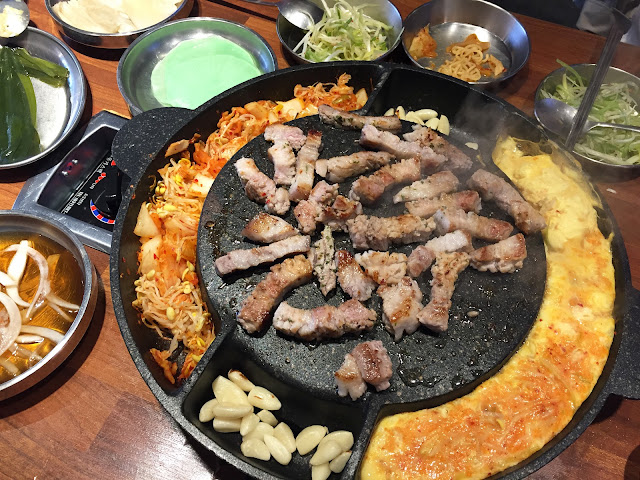
("Bornga" on Google Maps)
3F Busan Theater, 36 BIFF Gwangjang-ro, Jung-gu, Busan

We discovered 본가 The Born while we were strolling around BIFF. It was the poster advertising their menu that pulled us to the third floor of the same building as BIFF Theater.

My friend ordered 갈비탕 Galbitang (11,000 krw), which is beef rib soup. I ordered 차돌된장찌개 Chadol Doenjang (6,000 krw), which is soy bean paste stew served with bibimbap. This was a very very satisfying dinner.

Galbitang (top left), banchan or side dishes served on small white dishes,
and Chadol Doenjang with bibimbap (bottom)

Several branches across South Korea

Another lucky find was Premium Jjimdak, a restaurant serving jjimdak or braised chicken. We ordered a small Boneless Andong Jjimdak (18,000 krw) topped with cheese (3,000 krw). Their jjimdak is available in three sizes: small, medium, and large. Andong Jjimdak is a variety of jjimdak which originated from the city of Andong. As with all Korean restaurants, they also serve side dishes (salad, and pickled radish and cucumber). I am not crazy over cheese, but this was really good. The cheese was not overwhelming and it went well with the spicy Andong Jjimdak. I long to eat this again when I go back to Korea.

There are many branches of Premium Jjimdak in South Korea. The branch we visited is located near KyungSung University Station in Busan. It is on the second floor, above Etude House.


주전자 Jujeonja
37-9 Bupyeongdong 1(il)-ga, Jung-gu, Busan

On our last day in Busan, my Korean friend asked me what we wanted to eat for lunch, and I suggested samgyupsal. She brought us to Jujeonja in Jung-gu district and ordered samgyupsal and bibimbap. What is unique about their bibimbap is that it is served in a tin lunchbox, and to mix the bibimbap you just have to shake the lunchbox (with its lid on, of course!). One can never go wrong with samgyupsal and bibimbap!


Waffle Khan
1-1 Gwangbok-ro 55beon-gil, Changseondong 1(il)-ga, Jung-gu, Busan

Waffle Khan offers crunchy waffle sandwiches with many different fillings to choose from: apple, strawberry, blueberry, chocolate, cinnamon caramel, cinnamon almond, cream cheese, custard, kaya, mango, Nutella banana, Nutella kiwi, Nutella strawberry, ice cream, granola, etc. I really wanted to try all the flavors, but we had just had lunch, and my stomach only allowed me one waffle. I chose their bestseller: apple. So very yummy! Waffle Khan is the king of waffles!


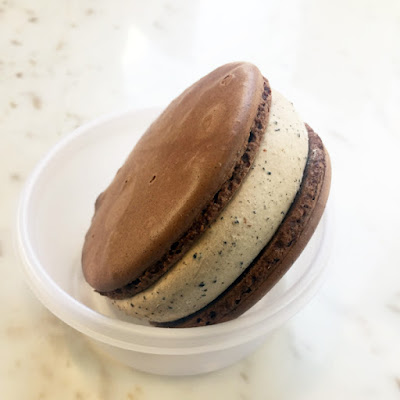
Paris Baguette—the ubiquitous bakery in South Korea—has so many good breads and pastries. There was never a visit in Korea where I did not go to Paris Baguette to buy something. On my last visit, I was pleasantly surprised to find an ice cream sandwich. It was no ordinary ice cream sandwich, it was a sinfully delicious macaron ice cream sandwich!


Dunkin Donuts

Yes, Dunkin Donuts is everywhere in the world. Yes, we have Dunkin Donuts in Cebu. No, we do not have their oh-so-soft blueberry bagels with real blueberries. This, Dunkin Donuts' blueberry bagel, is one of the things I look forward to eating whenever I am in Korea.


This article is now available as a mobile app. Go to GPSmyCity to download the app for GPS-assisted travel directions to the attractions featured in this article.


Jeju and Busan, April 2019
Jeju Accommodation: Jeju R Hotel & Guesthouse
Traveling Around Jeju by Bus Plus KakaoMap (2019)
Eats from Jeju City Restaurants I Can't Read the Names Of
Jeju City Lights: Iho Tewoo Beach and Jeju Light Art Festa
Geomun Oreum and Manjanggul Lava Tube
Art and Nature in Seogwipo City
Jeju Olle: Udo Island
Jeju Olle: Gapado Island
Busan Accommodation: One Way Guesthouse
Where and What We Ate in Busan (you're here!)

Wednesday, June 19, 2019

Busan Accommodation: One Way Guesthouse

For my fourth visit to Busan, I stayed at One Way Guesthouse in Dong-gu (Dong District), near Busan Station. (I have always stayed in Jung-gu (Jung District) in the past.)

12-5 Jungang-daero 196 beon-gil, Dong-gu, 48821 Busan
Telephone Number: +82 (51) 462 2500


Location. One Way Guesthouse is just a few steps from exit 4/6 of Busan Station. There is a convenience store right across the guesthouse and there are many restaurants nearby.

Room. We booked a double room with ensuite toilet and shower. (We would have preferred a twin room with two single beds, but their twin room only had bunk beds.) The room had a TV, air conditioner, small table, mirror, slippers, four power outlets (Type C/F), two hangers, and a towel bar. Shampoo, soap, hair dryer, and towels (hand towel size, which is usual in Korean hostels/guesthouses) were provided. The towel could be exchanged for a fresh one daily at the reception. Room entry is keyless—no keys to worry about, just don't forget your PIN!

Breakfast. We included breakfast when we booked the room. Breakfast—served starting at 8am—was a plate of salad, toast, jam, butter, sunny side up egg, fruit, and cup of tea or coffee. I liked that it had salad and fruit, but it was the same every day.

Price. The double room with ensuite toilet and shower only cost us 120000 krw (Php 5760) for 3 nights. That's Php 960 per person per night, and it already included breakfast.

Common Area. In the basement of One Way Guesthouse is the common area. They have a pool table and darts. There is also a kitchen where you can cook your own food.

Staff. The staff are friendly and can speak English well.

Luggage Storage. Free luggage storage is one of the services I look out for especially if my flight arrives too early for check-in or leaves too late after checkout. One Way Guesthouse allows guests to leave their luggage at the common area.


Heads up!
  • We booked our room through booking.com and the 300 krw tax was not included in the price quoted in the booking confirmation.
  • One Way Guesthouse has no elevator, which can be a problem if you have large/heavy bags and your room is on the 4th floor!
  • The toilet in our room had a certain smell and it wasn't pleasant!


Monday, June 17, 2019

Jeju Olle: Gapado Island

Jeju Olle is a series of trails that goes around Jeju Island plus trails around some surrounding islands—a total of 26 trails. If you hiked all 26 trails, then you would have traveled on foot 425 kilometers! Since I did not have the time (and, surely, not the energy) to do all 26 trails, I just picked two. And these two are trails that are not on Jeju Island but trails that go around two of its nearby islands: Udo Island and Gapado Island.

I picked Gapado Island (Jeju Olle Route 10-1) for two reasons. One, it's a short and very easy hike. The total distance of the trail is just 4.2 kilometers and can be done in an hour or two. Two, because it was the perfect time (April) to see the island's beautiful barley fields.

Getting to Gapado Island. From Jeju City, we took Bus 255 to Moseulpo Harbor (1.5 hours, 1150 krw). Moseulpo Harbor is the stop for Unjinhang Port where we will be taking a ferry to Gapado Island. At the port, we filled out a passenger report form, presented the form and our passports at the ticket counter and bought roundtrip tickets for Gapado Island (13100 krw, roundtrip). The ferry to Gapado Island runs every hour from 9am to 12 noon, then resumes at 2pm, 3pm, and 350pm (last trip). The return tip to Moseulpo Harbor is every hour from 920am to 1220pm, then 220pm, 320pm, and 410pm (last trip). The journey takes just 10 minutes. Heads up! There are two destinations: Gapado and Marado. Make sure you buy a ticket for Gapado.

Bus 255 schedule

Ferry to Gapado Island

Inside the ferry. Unlike the ferry to Udo Island, this one has seats.

Hiking around Gapado Island. There are bikes for rent (5000 krw) when you arrive at the port in Gapado. But it's such a small island that, in my opinion, walking would be the best choice. At the port, there were cafes, restaurants, and a few houses. We walked west following the coastal road as suggested by the trail map on the Jeju Olle website.


The trail is marked by blue and red ribbons, or blue and orange arrows (follow the orange arrows if you are following the trail in the reverse direction), or Ganse, which are horse-shaped trail markers (the head points in the direction of the route).

Trail markers

This Ganse informs the visitor that from this point one can see Marado Island

Marado Island in the distance

It was a sunny spring day with a light sea breeze blowing in, which made the coastal walk a very pleasant one. We saw some people sitting on the rocks by the sea and just enjoying their coffee and each other's company. The houses, I noticed, were small, one-storey buildings...most of them painted in the same color. Low walls made of stones separated the houses.


Hmmm...a slide at the port in Gapado?

Enjoying their coffee by the sea

The dwellings were small one-storey buildings mostly of the same color scheme

After a few minutes of walking along the coast, we could see a windmill and then the turnoff for the trail going inland.


The turnoff led to a vista of beautiful barley fields with the tall windmills (there were two) and blue sky creating a lovely backdrop. Not only that, it was a stunning walk through fields of barley and fields of canola flowers.


Fields of barley


Midway along the trail, we found stone statues and a yurt. I wondered what a yurt was doing in the middle of Gapado Island. It was actually not a dwelling place, for inside was nothing but ribbons with messages written on them by visitors. 


A yurt in Gapado?

So many ribbons with handwritten messages

I had to leave my mark, too.

Canola fields

We took our time walking this section of the trail, breathing in the fresh air and taking in 360 degrees of awesome nature. It was such a beautiful sight! But soon we had walked two-thirds of the trail and reached the east side of the island. The last third of the trail was to follow a concrete a road due south along the rocky coastline.


The trail ended at another port on the south of the island. Jeju Olle 10-1? check!

The port on the south of the island marks the end of Jeju Olle 10-1

But our hike did not end where the hiking trail ended. Of course, we had to go back to our starting point since we had to catch the ferry back to Jeju Island!


Jeju and Busan, April 2019
Jeju Accommodation: Jeju R Hotel & Guesthouse
Traveling Around Jeju by Bus Plus KakaoMap (2019)
Eats from Jeju City Restaurants I Can't Read the Names Of
Jeju City Lights: Iho Tewoo Beach and Jeju Light Art Festa
Geomun Oreum and Manjanggul Lava Tube
Art and Nature in Seogwipo City
Jeju Olle: Udo Island
Jeju Olle: Gapado Island (you're here!)
Busan Accommodation: One Way Guesthouse
Where and What We Ate in Busan